
Part One of Three: Building Your Health Pyramid
We tend to imagine that our long-term health will be determined by a few consequential moments.
The diagnosis. The blood test. The doctor’s appointment. The decision to lose weight, join a gym, stop drinking or begin a new treatment. More recently, perhaps, it is the full-body MRI, the supplement protocol, the continuous glucose monitor or the latest intervention promising to slow ageing.
Those moments can matter. Some may matter enormously. But I increasingly believe that the direction of our health is determined less by a handful of dramatic interventions than by the accumulation of perhaps 100 almost invisible decisions we make every day.
Do I drink a glass of water when I wake up or immediately reach for my phone?
Do I make the salad or open the bag of chips?
Do I take the stairs or wait for the lift?
Do I walk for ten minutes after dinner or collapse onto the sofa?
Do I stand up and stretch between meetings or remain hunched over the same screen for another two hours?
Do I take two minutes to breathe when I feel stressed, or carry that stress into the next conversation?
Do I dim the lights in the evening, call a friend, go to bed or watch one more netflix episode?
Individually, almost none of these decisions seems particularly important. One packet of chips will not ruin your health. One missed workout will not destroy your fitness. One late night will not meaningfully shorten your life.
But decisions do not remain individual for very long. They become patterns. Patterns become habits. Habits begin changing our biology, our energy and, eventually, our future.
Health rarely disappears overnight. More often, we trade it away quietly – or build it steadily – one micro-decision at a time.
The slow drift away from health
The human body is remarkably forgiving. It absorbs the poor night’s sleep, the stressful week, the missed workouts and the overly indulgent holiday. It adapts, compensates and continues.
That resilience is one of our greatest biological gifts. It can also disguise what is happening beneath the surface.
The consequences of our behaviour are rarely immediate enough to create a useful feedback loop. We can eat badly today without becoming visibly unhealthy tomorrow. We can sit for ten hours, sleep for five and still wake up able to function. We can drink too much, ignore stress and postpone movement while continuing to appear broadly fine.

Until, gradually, fine becomes tired. Tired becomes depleted. Depleted becomes a diagnosis – or simply a smaller life than the one we expected to be living.
The reverse is also true. A single healthy lunch does not transform our metabolism. One walk does not create cardiovascular fitness. One early night cannot erase months of inadequate sleep. The benefits arrive slowly, which makes the better decision easy to undervalue.
We are therefore asked to make choices today on behalf of a future body that cannot yet thank us.
That is the central challenge of long-term health: the immediate reward and the long-term outcome frequently point in opposite directions. The chips are available now. The healthier arteries are theoretical. The lift is convenient now. The ability to climb stairs confidently at 90 feels impossibly distant.
My own goal is to ski and play tennis on my 100th birthday. That sounds like one ambitious objective, but it will never be achieved through one ambitious decision. If I get anywhere close, it will be because of thousands of ordinary days and millions of small choices that preserved enough strength, energy, mobility, cognition and connection to keep those activities possible.
The destination may be dramatic. The path is mostly mundane.
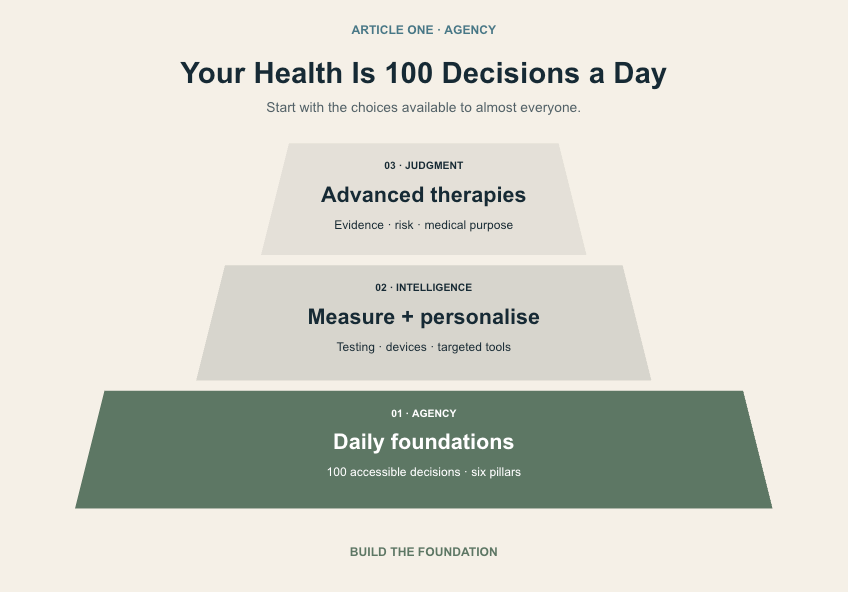
The health pyramid
This is the first of three articles about what I think of as the health pyramid.
The base contains the decisions available to almost everyone: how we eat, move, sleep, manage stress, reduce avoidable exposures and maintain purpose and connection. These choices are not glamorous, but they carry most of the weight.
The second level is measurement and personalisation. Bloodwork, medical history, fitness testing, wearables and other forms of data can help us identify which changes deserve our attention. Targeted tools such as sauna, cold exposure, red light, breath training and vagus nerve stimulation may then support a particular goal when used with purpose rather than novelty.
The narrowest level contains advanced clinical and emerging therapies: regenerative medicine, stem cells, plasma exchange, blood filtration, peptides, gene therapies and other interventions intended to repair damage or influence aspects of ageing. Some are established for specific medical conditions. Others remain investigational, commercially overpromoted or both.
The higher we climb, the more personalised, expensive, medically supervised and evidence-dependent the decisions become. But none of the higher layers eliminates the need for the one below it.
The top may contain the most exciting science. The base still carries the weight.
This first article deliberately stays at that base: 100 decisions almost anyone can begin making without joining a private club, buying a new device or waiting for technology to rescue them.
A different way to think about discipline
A list of 100 health decisions could easily become another exhausting checklist, and that is not my intention.
You are not supposed to perform all 100 perfectly every day. I certainly do not. This is not a purity test, a scoring system or an invitation to turn your life into an optimisation spreadsheet.
It is a way to notice how many opportunities we already have to influence the direction of our health.
Some decisions are about doing something: walking after dinner, preparing vegetables or calling a friend. Others are about not doing something: opening another bottle, beginning another episode or allowing a moment of stress to become an entire evening of agitation.
Many are environmental. Where did you leave the fruit? Is the phone charging beside the bed? Are your training clothes ready? Which lights come on after sunset? Is the healthy option easier to reach than the processed one?
This matters because willpower is an unreliable long-term health strategy. If every good decision requires an internal battle, eventually convenience will win. The more useful goal is to create a life in which the healthier choice becomes the easier, more visible and more socially supported default.
My lifestyle framework contains six interconnected pillars: food and hydration, movement, sleep, stress, toxin burden, and purpose and community. None operates independently. Poor sleep affects hunger. Stress changes food choices. Movement influences sleep. Community affects stress, purpose and behaviour. Toxin exposure can undermine the biological capacity we are trying to build through everything else.
Across those six pillars, here are 96 micro-decisions that can gradually change the direction of a life.
Pillar 1: Food and hydration
Nutrition is often presented through diets, restrictions and arguments over the perfect ratio of carbohydrates, fats and protein. Those questions have their place, but most of us have several more immediate decisions available before we need to debate nutritional ideology.
1. Drink a glass of water shortly after waking.
2. Keep water visible rather than waiting until you feel thirsty.
3. Carry a reusable bottle when leaving home.
4. Drink water with your meals rather than automatically choosing a sugary drink.
5. Build meals around protein, plants and fibre before adding the extras.
6. Add vegetables to breakfast or lunch rather than relying on dinner to rescue the day.
7. Make the salad rather than automatically opening the chips.
8. Choose whole fruit more often than fruit juice.
9. Keep healthier snacks visible and highly processed options less accessible.
10. Read the ingredients rather than trusting the health claim on the front of the packet.
11. Add another naturally coloured plant to the plate.
12. Eat slowly enough to notice when hunger has gone.
13. Pause before returning for seconds.
14. Decide what you will eat before you become ravenously hungry.
15. Prepare something simple at home before defaulting to takeaway.
16. Close the kitchen after dinner rather than grazing late into the evening.
None of these decisions needs to be universal. Individual nutritional needs vary, and medical conditions can change what is appropriate. The larger principle is to reduce the gap between knowing what generally serves us and what we repeatedly make convenient.
A healthy meal eaten once is simply a meal. A kitchen organised around recognisable food can change thousands of future decisions.
Pillar 2: Movement
Exercise is commonly treated as a scheduled event: the hour at the gym, the tennis match, the run or the fitness class. But our bodies experience all movement, not merely the portion we record as a workout.
Someone can exercise vigorously for an hour and remain almost completely sedentary for the other fifteen waking hours. Conversely, a person who walks, carries, climbs, bends and stands throughout the day may accumulate a meaningful amount of movement without ever labelling it exercise.
17. Take the stairs instead of the lift.
18. Walk up the escalator rather than standing still.
19. Park a little farther from the entrance.
20. Walk or cycle when the journey is reasonably short.
21. Take a ten-minute walk after a meal.
22. Stand up at least once every hour.
23. Stretch for two minutes between meetings.
24. Take a phone call while walking.
25. Suggest a walking meeting rather than another seated one.
26. Carry your own bags when it is safe to do so.
27. Sit on the floor occasionally and practise getting back up.
28. Perform a few squats while waiting for the kettle, shower or printer.
29. Include brief balance work while brushing your teeth or waiting in line.
30. Begin with five minutes when you do not feel like exercising.
31. Choose resistance that is challenging enough to preserve strength, while maintaining good form.
32. Choose an active experience with family or friends rather than another screen-based one.
The important decision is sometimes simply to begin. Five minutes can become twenty. One walk can alter the energy of an afternoon. Standing up can interrupt two hours of immobility.
Movement does not always need special clothing, a membership or a carefully periodised programme. Sometimes it needs a staircase and the decision not to wait for the lift.
Pillar 3: Sleep
Sleep is peculiar because we know it is essential, yet often treat it as the expendable residue left after everything else has been completed.
We rarely decide to sleep badly. We make a sequence of smaller decisions that delay sleep, fragment it or make it harder for the body to recognise that the day is ending. The final poor night begins hours before we get into bed.
33. Decide on a bedtime, not merely a wake-up time.
34. Begin preparing for sleep before you feel exhausted.
35. Dim the lights as the evening progresses.
36. Use warm lamps in the evening instead of bright overhead lighting.
37. Stop checking work messages at a predetermined time.
38. Put the phone outside the bedroom – or at least beyond arm’s reach.
39. Avoid beginning another episode when it will steal from tomorrow.
40. Choose sleep over another unnecessary scroll.
41. Keep the bedroom cool, dark and quiet.
42. Reserve the bed for sleep and intimacy rather than work, television and email.
43. Get outdoor light soon after waking.
44. Spend time outside during the day to reinforce the body’s natural rhythm.
45. Keep sleep and waking times reasonably consistent.
46. Avoid a large meal immediately before bed.
47. Notice whether alcohol makes you sleepy while degrading the night that follows.
48. Write tomorrow’s tasks down rather than carrying them repeatedly through your mind.
Sleep does not merely occupy the hours when nothing else is happening. It affects the decisions available the following day. When we are tired, movement becomes less attractive, stress becomes harder to regulate and highly rewarding food becomes more difficult to resist.
The decision to go to bed is therefore rarely just a sleep decision. It may shape dozens of tomorrow’s choices before tomorrow begins.
Pillar 4: Stress and recovery
Stress cannot – and should not – be removed from life. Some stress is useful. Challenge builds capacity. Ambition requires effort. Exercise itself is a form of stress from which the body adapts.
The problem is not that we experience stress. It is that many of us carry one stressful moment into the next hour, the next meal, the next conversation and eventually the night.
The useful micro-decision is often the interruption.
49. Take one slow breath before responding to a provocative message.
50. Use a two-minute breathing exercise when you notice tension building.
51. Lengthen the exhale when you need to reduce the intensity of the moment.
52. Step outside before deciding that you cannot cope.
53. Name what you are feeling rather than allowing it to drive the next decision unseen.
54. Ask whether the problem is immediate and actionable – or simply looping in your mind.
55. Put the phone down when outrage, comparison or bad news begins changing your state.
56. Create a small gap between an emotional trigger and your response.
57. Say no before resentment becomes the price of saying yes.
58. Protect ten minutes of unscheduled time in an overfilled day.
59. Spend a few minutes in silence rather than filling every gap with input.
60. Choose recovery after intense effort rather than treating exhaustion as achievement.
61. Ask for help before overwhelm becomes a crisis.
62. End the working day deliberately instead of allowing it to leak into the entire evening.
63. Write down the problem occupying your mind and identify the next useful action.
64. Choose not to pass your stress to the next person you encounter.
We cannot always choose what enters our lives. We often retain some agency over how long it remains in control.
Two minutes of breathing will not solve bereavement, financial pressure, trauma or a serious health problem. It may, however, prevent a stressed nervous system from automatically dictating the next choice. Small interventions should not be mistaken for complete solutions, but neither should they be dismissed because they are small.
Pillar 5: Toxin burden
Toxins are a difficult area because the term can quickly become vague, alarmist or commercially convenient. We should avoid pretending that every synthetic material is poisoning us – or that an expensive “detox” can erase years of exposure.
At the same time, our air, water, food, household products and habits create real exposures. We may not be able to control all of them, but we can reduce some without becoming obsessive.
65. Choose not to smoke or vape when the opportunity arises.
66. Decide that an ordinary evening does not automatically require alcohol.
67. Alternate alcoholic drinks with water when you do drink.
68. Avoid heating food in plastic when glass or ceramic is available.
69. Wash your hands before eating, especially after handling fuel, receipts or chemicals.
70. Use an extractor fan or other ventilation while cooking.
71. Check outdoor air quality before opening windows or exercising outside on a poor-air day.
72. Remove outdoor shoes at the door.
73. Choose fragrance-free products when fragrance serves no useful purpose.
74. Wash fresh produce before eating it.
75. Use ventilation while showering or cleaning to reduce moisture and fumes.
76. Refill a glass or stainless-steel bottle rather than repeatedly using disposable plastic.
77. Avoid mixing cleaning products unless the instructions explicitly say it is safe.
78. Read the label before bringing another cleaning product or cosmetic into the home.
79. Store solvents, pesticides and strong chemicals away from everyday living areas.
80. Refuse to let “detox” products distract you from reducing the exposures you can actually control.
The aim is not purity. It is sensible reduction.
We will never eliminate every unwanted exposure, and attempting to do so could create more anxiety than health. But we can stop voluntarily adding certain burdens simply because they have become normal or convenient.
Pillar 6: Purpose and community
This pillar may be the easiest to overlook because its effects are less visible than food, exercise or sleep. Connection does not arrive with a nutrition label. Purpose cannot be counted in steps.
Yet a long life without belonging, usefulness or people with whom to share it is a fairly impoverished version of longevity.
Our social health is also built through micro-decisions. Relationships rarely disappear in a single moment. More often, we fail to make the call, accept the invitation, apologise, listen or say what someone means to us.
81. Call someone rather than merely liking their post.
82. Eat one meal with another person without competing screens.
83. Introduce yourself to someone new.
84. Ask a better question and listen fully to the answer.
85. Put your phone away when someone is speaking to you.
86. Tell someone specifically why you appreciate them.
87. Offer help before being asked.
88. Accept an invitation when isolation would be easier but connection would serve you better.
89. Decline an invitation when attendance would conflict with something that matters more.
90. Repair a small disagreement before it hardens into distance.
91. Learn the name of someone you see regularly.
92. Spend more time with people whose habits support the person you want to become.
93. Join a group organised around movement, service, learning or shared purpose.
94. Do one thing that makes you useful to another person.
95. Make time for something meaningful that produces no obvious professional return.
96. End the day by asking whether you connected, contributed or merely consumed.
Community is not something we simply have. It is something we repeatedly choose.
The decision to send the message, attend the dinner or ask the second question may seem inconsequential. But repeated over decades, these choices determine whether we are surrounded by genuine relationships or merely connected to hundreds of people through a screen.
The four decisions that make life worth extending
That gives us 96 practical decisions across the six pillars. But a framework concerned only with optimising behaviour would be incomplete.
We could follow every rule, measure every marker and become so disciplined in the pursuit of longevity that we forget to enjoy the life we are attempting to extend.
Health is not the ultimate objective. Health is what allows us to participate more fully in everything else.
The final four decisions are therefore different. They are not attached to one pillar because they give meaning to all six.
97 Choose presence
Put down the phone, stop rehearsing what comes next and give your attention to the person, place or experience in front of you.
Presence may be one of the rarest resources in modern life. We are physically in one place while mentally answering an email, reviewing yesterday or planning tomorrow. A life can become remarkably full and still be barely experienced.
98 Make room for joy
Do something simply because it makes you laugh, dance, play, sing or feel alive – not because it is productive, measurable or supposedly good for you.
Joy does not always need to be earned after the serious work is complete. It is part of the serious work.
99 Leave space for spontaneity
Do not optimize every minute. Take the unplanned walk. Accept the unexpected invitation. Stay for another conversation. Change the agenda because something more interesting has appeared.
Routines help us make better decisions, but a life with no room for surprise can become efficient and strangely lifeless.
100 Return without judgment
You will not make the healthier decision every time, nor should you.
Enjoy the dinner. Miss the workout. Stay up late with friends. Have dessert. Spend the afternoon doing absolutely nothing useful.
Then make the next decision well.
Perfection is not only impossible; it can become its own form of poor health. The shame attached to one imperfect decision often causes more damage than the decision itself. One missed workout becomes a lost week. One indulgent meal becomes a reason to abandon the entire effort.
Long-term health is built through direction and repetition, not purity.
Are all decisions equal
Of course not.
Smoking a cigarette and failing to stretch for two minutes are not equivalent. Chronic sleep deprivation cannot be offset by eating another vegetable. Serious illness cannot be prevented or reversed merely by making sufficiently virtuous lifestyle choices.
Genetics, income, environment, trauma, access to care and simple luck all influence our health. Any honest framework must acknowledge that not everyone begins with the same biology, resources, safety or available decisions.
Nor should people with illness be made to feel that they somehow accumulated the wrong choices. Behaviour influences risk; it does not create complete control.
But uncertainty is not the same as powerlessness.
We may not control the body we inherited or every event it will encounter. We do have some influence over the conditions in which that body lives today. Even when the available choices are constrained, direction still matters.
The objective is not to assign identical values to 100 actions. It is to make the decision points visible.
Build the default not just the motivation
There is another reason to look at health through micro-decisions: it changes what we build around ourselves.
If health is determined only by individual discipline, then every failure belongs to the person. But if daily environments shape hundreds of decisions, responsibility becomes shared.
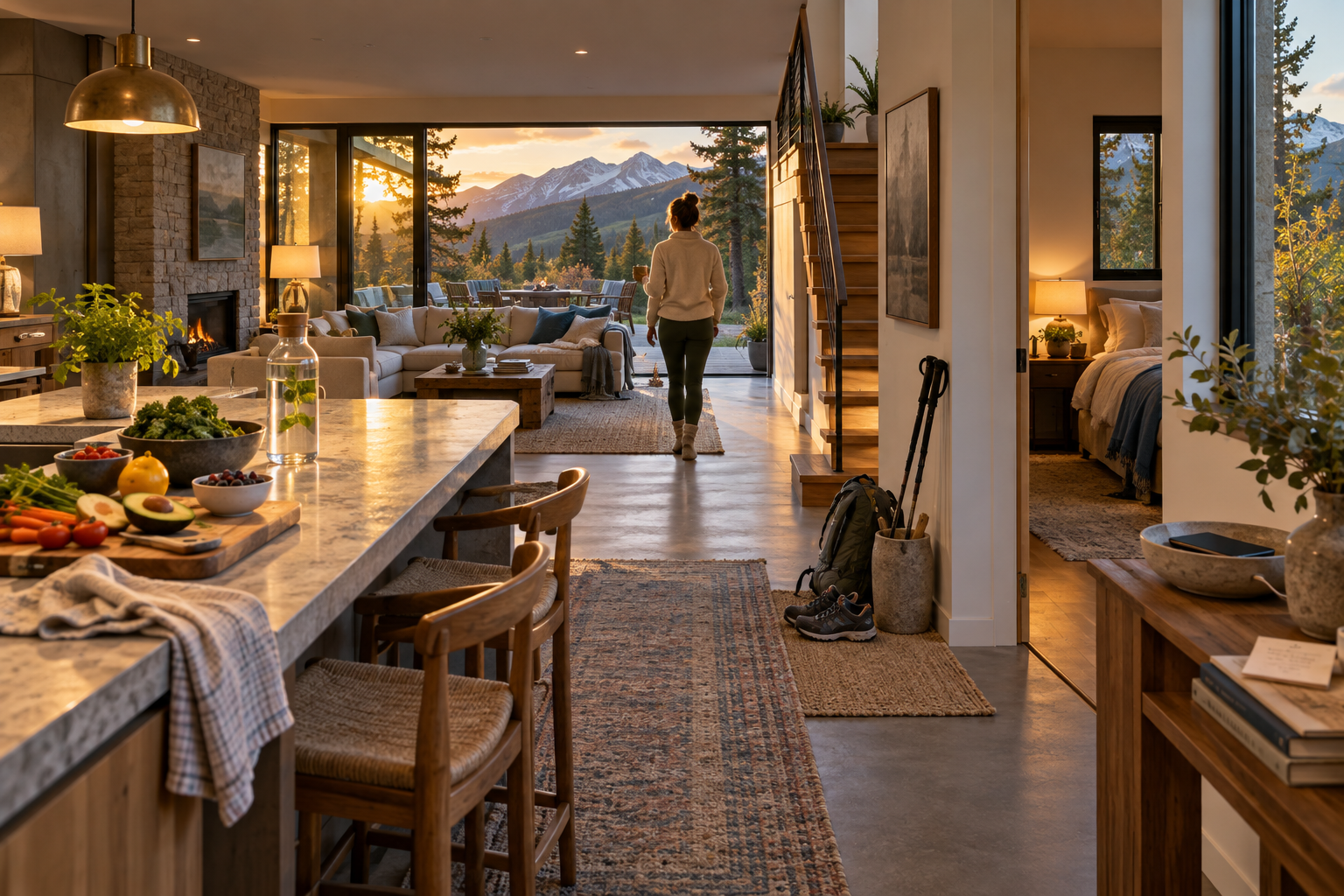
A home can make sleep easier through darkness, temperature and quiet. A workplace can make movement easier through stairs, standing areas and walking meetings. A restaurant can make healthy food attractive rather than punitive. A town can make walking and cycling convenient. A community can create places where belonging happens repeatedly rather than accidentally.
This is central to what we are building at Argentis Haus and to my larger ambition of helping Park City become an intentionally designed modern American Blue Zone.
A healthier community is not simply one that tells people what they should do. It is one that changes the architecture of everyday decisions.
If the healthy option remains expensive, inconvenient, lonely and hidden while the unhealthy option is cheap, immediate and everywhere, education will only take us so far. The real opportunity is to design healthier defaults into our homes, workplaces and communities.
The best health intervention may occasionally be the one you barely notice.
Foundations before accelerators
There is nothing wrong with being interested in sauna, cold plunges, red light, vagus nerve stimulation, supplements, peptides or the growing range of recovery technology. I use and explore some of these tools myself. They may have a useful place when the goal is clear, the evidence is understood and the response is measured.
But they should not distract us from the foundation.
We increasingly use hundred-dollar tools to recover from ten-dollar decisions. We stay up too late and then look for a device to restore our energy. We remain sedentary all day and expect a brief intervention to undo it. We collect more data while continuing to ignore the behaviour the data keeps identifying.
The most advanced recovery technology cannot continually rescue us from neglected foundations.
That does not mean we should reject useful tools merely because they are new. It means we should understand where they belong in the pyramid. First build the foundation. Then measure the individual. Then intervene with purpose.
One hundred decisions one direction
Most of us already know a surprising amount about what supports health. The challenge is rarely another piece of information. It is turning knowledge into repeated behaviour in the middle of an ordinary day.
Drink the water.
Make the salad.
Take the stairs.
Walk after dinner.
Stand up.
Breathe before reacting.
Dim the lights.
Call the friend.
Go to bed on time.
Then, occasionally, abandon the plan, follow the music, stay for the conversation and enjoy being alive.

If the pursuit of longevity removes joy, spontaneity and presence from your life, you may be extending the very thing you have forgotten how to enjoy.
Your health will not be determined by winning every decision. It will be shaped by making enough helpful choices, often enough, that your body continues moving towards greater energy, resilience and possibility.
Not perfection. Direction.
For the next 24 hours, do not attempt to change everything. Simply notice the decision points. Which choices are moving you towards the person you want to become, and which have become almost invisible withdrawals from your future health?
Then add your experience in the comments: what is one micro-decision you already make consistently – and what is one small decision you will change tomorrow?
Next in the series
In Part Two, I will move to the middle of the health pyramid and explore how bloodwork, medical history, fitness testing, wearables and recovery tools can help us move beyond general advice towards a more personal health strategy. The question will not be how much data we can collect, but whether that data leads to a better decision.
Part Three will examine the narrowest and most complex level: advanced and emerging therapies such as regenerative medicine, stem cells, plasma exchange, blood filtration and gene therapy – including how we might distinguish credible medical progress from expensive experimentation and longevity hype.