
Why I think we’ve been measuring health backwards.
I’m beginning to think we have made health far too complicated. It has somehow become both incredibly clever and unnecessarily difficult to understand. The first part is fair enough. The human body is astonishingly complex, and every year we discover another layer of biology that reminds us how much we still do not know.
At the same time, the basic system is remarkably elegant. The body contains tens of trillions of cells, all working around the clock to keep us alive. While you are reading this, they are producing energy, repairing tissue, replacing damaged cells, fighting infection and generally getting on with their jobs without making a fuss. Rather British, really.
You do not have to remember to heal a paper cut. You do not consciously tell your heart to beat roughly another hundred thousand times today, or ask your immune system to clock in when a virus appears. Your body simply gets on with it.
The question that has consumed me over the past decade is what makes that extraordinary system begin to fail, and whether we can spot the signs early enough to do something useful about it. By the time pain or disease appears, the underlying problem may have been developing quietly for years. I am much more interested in what happens before the diagnosis, while the body is still adapting, compensating and trying to keep everything moving in the right direction.
For me, that question was never academic. It began with my younger brother.
A promise to my future self
Twenty-five years ago, my brother was involved in a tragic accident that very nearly took his life. The years that followed were not about recovery in the way most people imagine it. They became a twenty-five-year lesson in resilience, determination and what it really means to rebuild a life, one small step at a time.
Watching that unfold changed something in me. It reminded me that health is not something we should consider only once we have lost it. It is easy to assume there will always be another decade, another birthday or another opportunity to take better care of ourselves. The truth is that none of us knows how much time we have been given. What we can influence is the quality of that time.
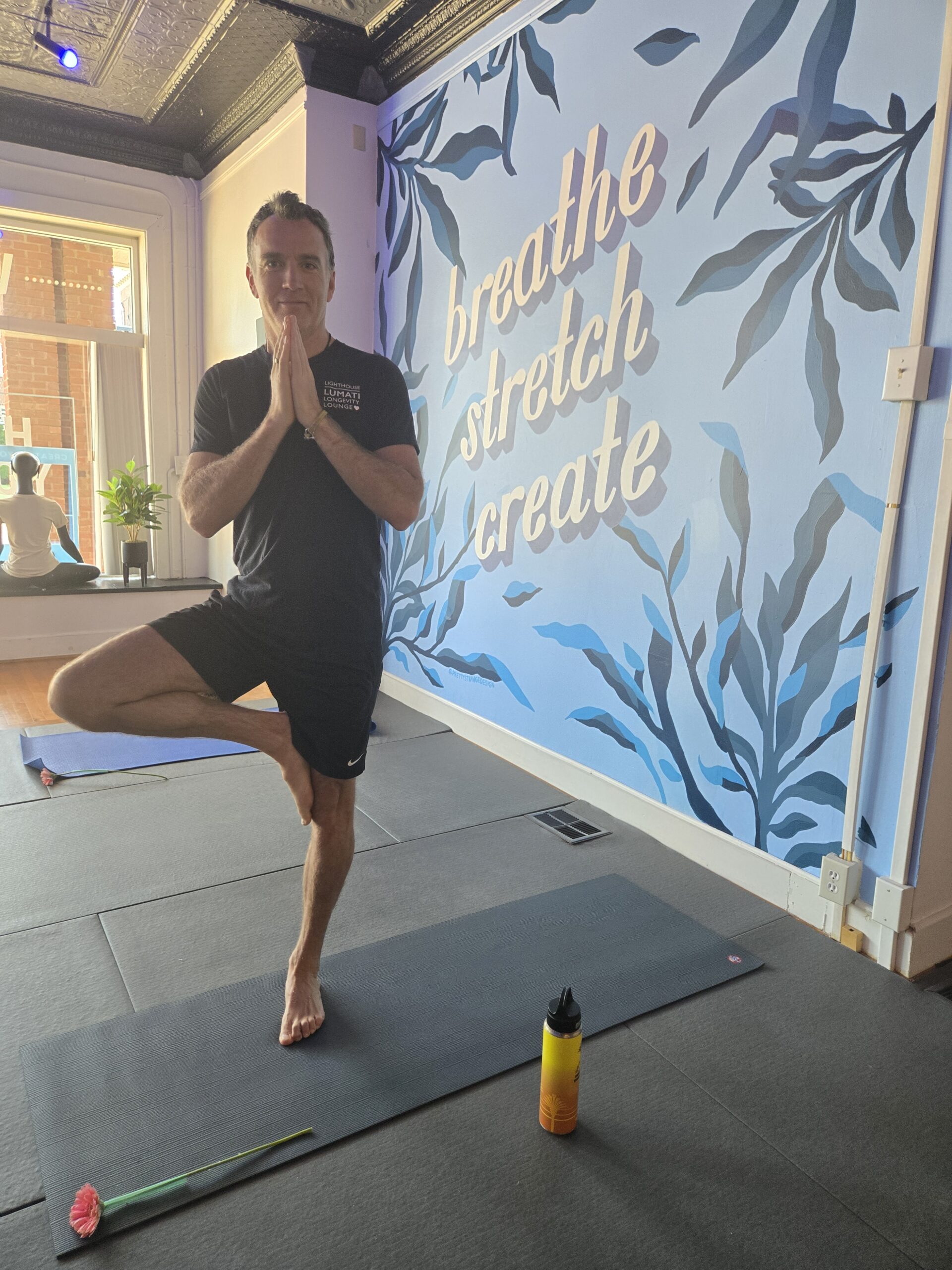
Not long after my brother’s accident, I made myself a promise that has quietly shaped almost every important decision I have made since: I wanted to ski and play tennis on my hundredth birthday.
People often smile when I tell them that. Some assume it is an ambitious bucket-list goal or a slightly eccentric conversation starter. It is neither. It has become my compass. Whenever I face a decision about my health, I find myself asking a remarkably simple question: does this increase the chances of me standing at the top of a ski run when I am one hundred years old?
What surprised me was how powerful that single question became. It influenced far more than exercise. It changed how I thought about sleep, nutrition, recovery, stress, relationships and even the places I wanted to live. More recently, it has shaped the companies I have chosen to build and my belief that our homes and communities should actively contribute to our health rather than quietly work against it. A promise about skiing became a framework for making thousands of small decisions over a lifetime.
I have also come to believe that everyone needs a reason to be healthy that is bigger than avoiding disease. Fear is a poor long-term motivator. It may change our behaviour for a few weeks, but it rarely sustains change for years. Purpose has a habit of doing so almost without our noticing.
For one person, that purpose might be watching grandchildren grow up. For another, it might be hiking the Inca Trail, dancing at a daughter’s wedding or simply remaining independent. The goal matters less than the fact that it is deeply personal. When the why is strong enough, healthy choices feel less like sacrifice and more like logical steps towards a future that matters.
That was true for me. But it also led to a larger question. If a meaningful purpose could help me make better decisions, how would I know whether those decisions were actually working?
The missing feedback loop
Like many people who become interested in longevity, I fell down the rabbit hole. What began as curiosity became something closer to an obsession.
I had the biological age tests. I wore the wearables. I had comprehensive blood work, functional medicine assessments, metabolic testing, body composition scans, heart imaging, brain imaging, continuous glucose monitoring and enough health reports to wallpaper my office. Every few weeks there seemed to be another fascinating metric to measure or another expert suggesting a new protocol.
To be fair, I learnt a great deal. Some of the results were reassuring. Others reminded me that none of us is quite as bulletproof as we would like to believe.
But once the excitement of collecting data wore off, I found myself asking a simpler question: now what?
If I slept an extra hour each night, which measures should improve? If I stopped drinking alcohol for a month, how long would it take to see a meaningful change? If I built more muscle, improved my nutrition or reduced my stress, how would I know whether I was genuinely becoming healthier rather than simply feeling virtuous?
The answers were frustrating because biology operates on several clocks. Some signals change within days; others take months or years. Conventional markers may remain reassuring while a person feels their capacity, recovery or resilience slipping. No single measurement can explain the whole system, and more measurements do not necessarily create more understanding.
As an entrepreneur, that felt backwards.
In business, we depend on feedback loops. If customers stop buying a product, we know quickly. If a marketing campaign is not working, we do not wait a year before changing course. We gather information, learn, adapt and improve.
Health offers a much murkier loop. We make choices today, yet struggle to see how they affect the health we will have years from now. Wearables have shortened parts of that loop, but they can also leave us with a brightly coloured collection of scores without answering the question that matters: am I becoming more capable or slowly losing ground?
That struck me as one of the biggest opportunities in health. What if we could understand whether our daily choices were strengthening or weakening the systems that sustain us, long before disease made the answer obvious?
A better first question
Very few of us wake each morning wondering what our cholesterol is doing. We do not lie awake thinking about mitochondrial efficiency or inflammatory pathways. What we want is simpler. We want to feel good for longer. We want enough capacity to play with our children and, one day, our grandchildren. We want to climb mountains, build businesses, travel, laugh, learn and remain physically capable of doing the things that give life meaning.
Longevity researchers sometimes describe this ambition as compressing morbidity: postponing illness, frailty and loss of independence so that they occupy as little of later life as possible. Others call it extending healthspan rather than lifespan. Whatever language we use, the point is not to cheat death. It is to remain capable for longer.
Many measures of physical capacity peak in early adulthood and tend to decline with age, although the rate varies enormously. Genetics matter, but so do behaviour, environment, medical care and circumstances we do not control. Some people appear old at fifty; others are still skiing black runs at eighty. The interesting question is what allows one person to preserve capacity while another loses it much earlier.
That is where I keep coming back to energy.
What if ageing is not only a story about time passing, but also about the changing condition of the systems that allow us to produce, use and restore the energy required to function? What if energy gives us a useful way to connect choices made today with capacity preserved tomorrow?
I need to be precise here. I am not suggesting that feeling energetic proves that someone is healthy, or that low energy causes every disease. Fatigue can have many causes, from a poor night’s sleep to a medical condition that deserves proper investigation. Nor am I proposing that energy replace cholesterol, glucose, blood pressure, inflammation or any other established measure. Biology is rarely obliging enough to be explained by one idea.
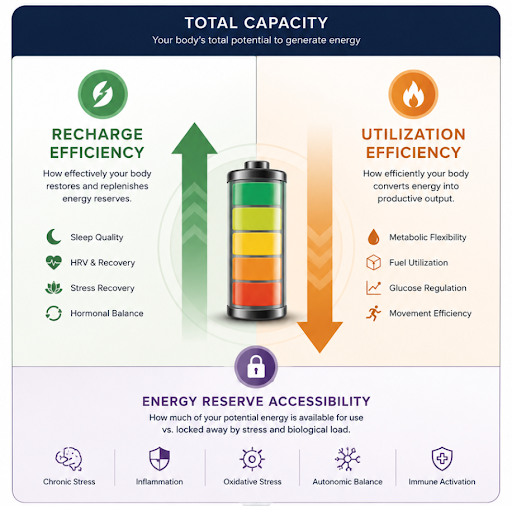
I am interested in something more specific: the condition of the interconnected systems that create, distribute, use, restore and protect the energy on which human function depends.
At its simplest, energy is the capacity to do work. In the body, that work includes a heartbeat, a muscle contraction, an immune response, a clear thought and the repair of damaged tissue. Cells convert fuel and oxygen into usable energy, much of it carried through ATP. Mitochondrial dysfunction is recognised as one of several hallmarks associated with ageing, alongside changes such as chronic inflammation, cellular senescence and loss of proteostasis. It is part of the story, not the whole story.
The difficulty is that useful human energy cannot be understood by looking at one molecule, one blood marker or one moment in time. Measuring ATP in a cell would tell us very little about whether a person can think clearly through the afternoon, recover from exercise, resist infection or adapt to sustained stress. The more useful question may be how well the whole system is meeting demand while preserving enough reserve for the unexpected.
Think about a phone that suddenly drops from 80 per cent battery to 10. You probably would not begin by polishing the screen or congratulating yourself because the speaker still works perfectly. You would ask what is draining the battery.
It strikes me that we rarely ask the equivalent question about ourselves. We track outputs, compare scores and watch warning lights, but often struggle to connect them to what is happening underneath. Whether we are building a company, climbing a mountain, recovering from illness, raising three children or simply getting through a busy Tuesday without a third coffee, we are relying on biological capacity: the ability to think, move, recover and adapt.
Sleep influences it. Movement trains it. Nutrition supports it. Stress makes demands upon it. Relationships and surroundings can help replenish us or keep us in a state of strain. Disease can diminish it. None of those statements makes energy a universal diagnosis. But together they make me wonder whether energy could be the organising idea that helps ordinary people understand how these parts relate.
Human Energy Intelligence
That question now runs through much of what I am building. It sits behind Argentis, shapes my thinking about healthier homes and communities, and is part of why I have become slightly obsessed with helping Park City become a modern Blue Zone. It is also why I am writing a book.
Not because I think I have found the answer. I have not. I think I may have found a better question.
Over the past few years, I have been developing a framework I call Human Energy Intelligence™. It is an attempt to connect three things we tend to consider separately: how we live, how our biology responds and how capable we remain over time.
The framework begins with a distinction between energy and energy intelligence. Energy is the capacity that makes life possible. Energy intelligence is our ability to understand what strengthens that capacity, what depletes it, how effectively we restore it and whether our reserve is improving or eroding. One belongs to biology. The other is a way of seeing and acting.
I am also exploring whether a Health Energy Index could make that relationship more visible. I do not see it as a direct measurement of energy in the narrow biochemical sense, and certainly not as one magical score that explains the human body. It would be an attempt to understand the condition of the systems that make useful human energy possible by connecting signals related to metabolic health, sleep, movement, recovery, stress, inflammation and physiological reserve with changes in daily behaviour and performance.
Two people can be the same age and have similar body weight, blood pressure and cholesterol, yet function very differently. One may wake refreshed, exercise well and recover quickly. The other may rely on caffeine to get started, feel foggy and run out of steam by mid-afternoon. That does not diagnose either person. It does suggest that conventional snapshots may not capture everything we mean by being well.
The hypothesis behind Human Energy Intelligence™ is that changes in capacity, recovery and reserve may help us notice strain earlier and understand our existing health data more coherently. The sequence will not be neat. Daily behaviour affects biology; biology shapes performance and recovery; environment, illness and chance complicate everything. Any index worth trusting would need rigorous scientific development, prospective validation and clear evidence that it adds value beyond the measures we already have.
That last sentence matters. We have enough seductive health scores. I am not interested in creating another number merely because technology makes it possible. The test is whether a framework helps people make better decisions, helps clinicians see something useful earlier or reveals connections that isolated measurements miss. If it cannot do those things, it is decoration.
The bigger question
So what should any of us do differently tomorrow?
I would begin before the biomarkers, with three questions. What am I asking my health to make possible? Which parts of my life reliably build or drain my capacity? And, over time, am I becoming more able to meet the demands of my life and recover from them, or less?
Those questions do not replace medical care, and they will not produce a perfect answer by breakfast. They do something more useful: they turn health from an abstract attempt to avoid future disease into a living feedback loop between what matters to us, how we live and what our bodies appear able to do.
For me, the answer still begins at the top of a ski run on my hundredth birthday. That image gives the data a purpose. It reminds me that the point of sleep is not a better sleep score. The point of exercise is not a higher VO2 max, valuable though it may be. The point of health is not to become exceptionally good at monitoring health.
The point is to have the energy and capacity to keep participating in life.
I may be wrong that energy is the best organising idea for all of this. Human biology has humbled considerably cleverer people than me. But I am increasingly convinced that we have spent too long measuring health as a collection of separate outputs and not enough time asking about the system that produces them.
Perhaps we have been measuring health backwards. Perhaps the better place to begin is not with what is wrong, but with what makes everything else possible…your energy.
If you want to dive into this topic in more detail, then take a look at this more detailed post on the Human Energy Index™.
Selected sources
Hatton, I. A., Galbraith, E. D., Merleau, N. S. C., Miettinen, T. P., Smith, B. M., & Shander, J. A. (2023). The human cell count and size distribution. Proceedings of the National Academy of Sciences, 120(39), e2303077120. View source
Fries, J. F. (1980). Aging, natural death, and the compression of morbidity. The New England Journal of Medicine, 303(3), 130-135. View source
Lopez-Otin, C., Blasco, M. A., Partridge, L., Serrano, M., & Kroemer, G. (2023). Hallmarks of aging: An expanding universe. Cell, 186(2), 243-278. View source