

I recently came across an Instagram post showing a doctor standing in front of a whiteboard headed “Longevity Supplement Cheat Sheet.” Underneath was a formidable list: PQQ, NMN, CoQ10, astaxanthin, resveratrol, taurine, dihydroberberine, spermidine, glycine, quercetin, fisetin, NAD boosters, SIRT activators and AMPK activators. If you spend any time in the longevity world, you will have seen some version of this list before. I have probably taken some of the things on it myself.
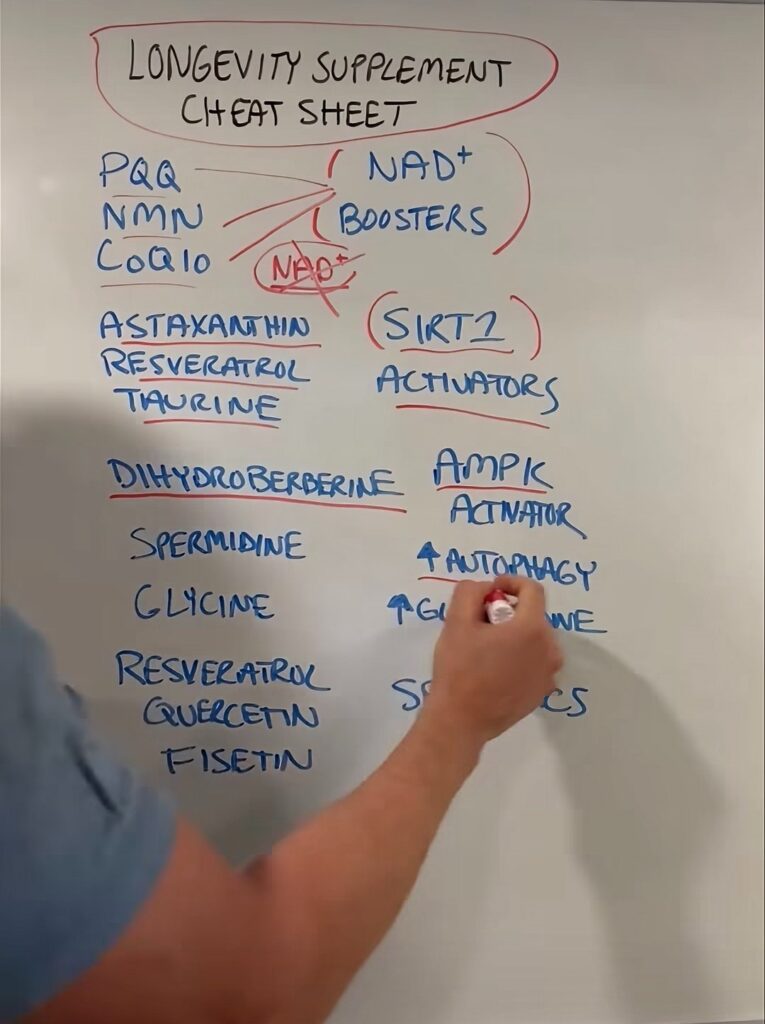
My reaction wasn’t that these compounds are all nonsense. Some are genuinely interesting, and I remain fascinated by the emerging science of ageing and the possibility that we may eventually be able to influence biological processes that previous generations simply had to accept. My reaction was more basic: how do you know I need any of them?
That question seems strangely absent from much of the longevity supplement conversation. We have become remarkably sophisticated at discussing molecular pathways, mitochondria, NAD, AMPK, autophagy and cellular senescence, while sometimes skipping over the human being who is about to swallow the pill. What are we actually trying to improve? How do we know it needs improving? Is a supplement the best way to improve it? And if we take something every morning for the next ten years, how will we know whether it actually did anything?
Before deciding what to put into the body, I think we should make a reasonable attempt to understand what is happening inside it.
The longevity stack is backwards
There is a pattern in longevity culture that I think has the process backwards. Researchers identify a biological pathway associated with ageing. A compound appears to influence that pathway. Early research produces an interesting result, perhaps in cells, animals or a small group of humans. Before long, the compound appears on a podcast, then in somebody’s supplement stack, and eventually on a whiteboard telling thousands of otherwise healthy people what they should be taking.
The underlying science may be perfectly legitimate. Increasing NAD is interesting. AMPK, autophagy and cellular senescence are enormously important areas of research. The problem occurs when we quietly make the leap from understanding a mechanism to assuming that manipulating it with a supplement will meaningfully increase human healthspan.
A mouse living longer after an intervention is interesting science. So is a molecule affecting an ageing pathway in a cell, or a supplement changing a biomarker in a human trial. But none automatically tells me whether taking that supplement for years will help me remain strong, cognitively capable, metabolically healthy and physically active into old age. There is a lot of scientific territory between those conclusions, and much of the longevity industry lives commercially in that gap.
You can’t be deficient in longevity
Part of the problem is that “longevity” has become something we talk about as though it were a condition we can treat. You cannot take a blood test and discover that you are deficient in longevity. What you can discover are individual risks, deficiencies and areas of declining function that may reduce the probability of living a long and healthy life.
One person may have impaired glucose regulation. Another may have elevated ApoB or high blood pressure. Someone else may have poor cardiorespiratory fitness, inadequate muscle mass or excess visceral fat. There may be a genuine vitamin or mineral deficiency, consistently inadequate sleep, chronic stress, excessive alcohol consumption or simply a diet that is working against almost every other health intervention being attempted.
These are very different problems and deserve different responses. More importantly, many can be measured, which means we can establish where somebody is today, decide what we want to change, intervene and then see whether it actually changed.
That has become the hierarchy I increasingly use when thinking about my own health:
Measure → Identify → Lifestyle → Targeted Intervention → Remeasure.
It is admittedly less exciting than a longevity supplement cheat sheet. It also makes it much harder to sell everyone the same bottle of pills.
Measure what matters first
We are entering an extraordinary period in personal health measurement. Blood testing is becoming more accessible, wearables can provide longitudinal information about sleep and activity, continuous glucose monitors can reveal glucose responses in selected circumstances, and technologies such as DEXA and VO₂max testing can tell us considerably more about body composition and cardiorespiratory fitness than we could easily know a generation ago.
The answer isn’t necessarily to test everything simply because we can. I am more interested in measurements that reveal something actionable about established disease risk, nutritional status or physical capacity. Depending on the individual and clinical context, that could include glucose and HbA1c, blood pressure, conventional lipid measurements, ApoB and Lp(a), with additional measures such as fasting insulin, hs-CRP or CGM data potentially providing useful context. Nutritional testing can identify specific deficiencies where someone’s diet, symptoms or medical history give us a reason to look.
Then there is another category that interests me just as much: what can your body actually do? Cardiorespiratory fitness, strength, muscle mass, body composition, waist circumference, mobility, balance and sleep patterns tell us something about the organism we are hoping will carry us through another few decades. These aren’t all universal medical screening tests, and I don’t want to pretend they are. Some are established clinical measures while others are additional healthspan measurements that I personally find useful.
If I know someone’s blood pressure, ApoB, glucose regulation, cardiorespiratory fitness, strength, body composition and sleep pattern, I probably have a much better idea where to focus than I would from knowing whether we can push their NAD level a little higher.
Before supplements, look at the lifestyle
Now imagine someone taking NMN, PQQ, resveratrol, spermidine and fisetin every morning while rarely strength training, sleeping six hours a night, eating predominantly ultra-processed food, drinking more alcohol than they probably should and carrying excess visceral fat. At some point we have to ask what, exactly, we are optimising.
This is where my Six Pillars of Longevity framework comes in. I developed it over years of working around lifestyle change and using the same ideas to improve my own health. The pillars are Nutrition, Movement, Sleep, Stress, Toxins, and Purpose & Community. I have written separately about why I believe these should form the foundation of a healthspan programme, and why the framework I developed independently mapped so closely to the established principles of lifestyle medicine.
Exercise, food and sleep aren’t the unsophisticated things we did before longevity science arrived. They influence many of the same biological systems we are now attempting to manipulate through supplementation. Movement affects insulin sensitivity, cardiovascular fitness, muscle preservation and mitochondrial function. Diet influences glucose regulation, lipids, body composition and nutrient status. Sleep affects recovery, cognition, appetite and metabolic regulation, while chronic stress, smoking and excessive alcohol can undermine several systems at once.
I have become increasingly interested in a simple principle: before adding something, see how much can be achieved by improving the system that is already there. Supplements can have a role, but I think they should have to earn it.
A hierarchy for intervention
The clearest case for supplementation is probably also the least glamorous. If testing demonstrates a genuine nutritional deficiency and supplementation is appropriate, correct it. B12, iron or vitamin D might fall into this category depending on the person and their clinical circumstances. Vitamin D deficiency is a recognised condition, but supplementation is not a case of “more is better”; NIH guidance recommends discussing need and dose with an appropriate healthcare professional. Iron makes the same point even more strongly because excessive intake can itself be harmful.
The next priority is measurable health risk or loss of physical capacity. Elevated ApoB, hypertension, poor glucose control, excess visceral fat, inadequate muscle mass or low cardiorespiratory fitness tell us considerably more about where to focus than a generic longevity stack. Lifestyle may substantially improve some of these problems, while others may require appropriate medical treatment. Either way, the intervention begins with the person and the problem rather than the product.
Once the foundations are reasonably strong, evidence-supported optimisation becomes more interesting. Someone trying to build or preserve muscle may need to look carefully at protein intake. Creatine is a useful example because it has been studied extensively in humans and has reasonably strong evidence for improving strength, power and performance during repeated high-intensity activity. That doesn’t make creatine a universal longevity supplement, but it does show what a much more mature evidence base looks like.
Only after that do I arrive at what I think of as experimental longevity: NMN or NR, spermidine, PQQ, fisetin, resveratrol and various strategies aimed at NAD, sirtuins, senescence and other ageing pathways. I find this part of longevity science intellectually fascinating and don’t think it should be dismissed because the evidence isn’t complete. I may experiment with some of it myself. But interesting geroscience, promising human data and a proven intervention that improves meaningful human healthspan outcomes are not interchangeable ideas.
What happens when you test the cheat sheet?
Some of the compounds on the whiteboard illustrate the problem particularly well. Berberine at least gives us the possibility of beginning with a measurable metabolic question. If somebody has impaired glucose regulation, we can ask whether a particular intervention might improve a defined outcome. That still doesn’t mean every healthy person should take berberine, and questions around medication interactions, dosing and supplement quality make individual context important.
CoQ10 provides another useful lesson. It has been studied in people experiencing statin-associated muscle symptoms, but the research has not produced a perfectly clean answer. A 2020 meta-analysis found no significant benefit, whereas a newer 2025 analysis of seven randomised trials reported an overall reduction in pain but also noted small sample sizes, heterogeneity and the need for better studies. That uncertainty is itself useful. “CoQ10 may be useful in a specific clinical context” is very different from “CoQ10 belongs in everyone’s longevity stack.”
Glycine and taurine are perhaps even better examples of how quickly an interesting ageing hypothesis can become a supplement recommendation. A systematic review of glycine found some encouraging human signals, including sleep-related findings, but the studies in healthy populations were generally small and the authors called for larger, longer and more rigorous trials before drawing conclusions about healthy ageing.
Taurine became particularly fashionable after striking animal research suggested a connection with ageing. But subsequent NIH-led work examining humans, monkeys and mice found that circulating taurine did not consistently decline with age and was inconsistently associated with health outcomes, challenging the idea that taurine decline is a universal ageing biomarker. That doesn’t prove supplementation has no value. It shows how quickly a compelling biological story can become more complicated when better human data arrive.
NMN and other NAD precursors bring us back to the same issue. NAD biology is fascinating, and influencing NAD-related pathways may eventually prove important. Demonstrating that an intervention changes NAD-related biology is valuable scientific information, but changing a biomarker and demonstrating a meaningful improvement in human healthspan are different achievements. The same caution applies, to varying degrees, to spermidine, PQQ, resveratrol and fisetin. I want to follow the science; I simply don’t think “fascinating area of geroscience” should quietly become “something every healthy person should take every morning for the next thirty years.”
Four questions before adding another bottle
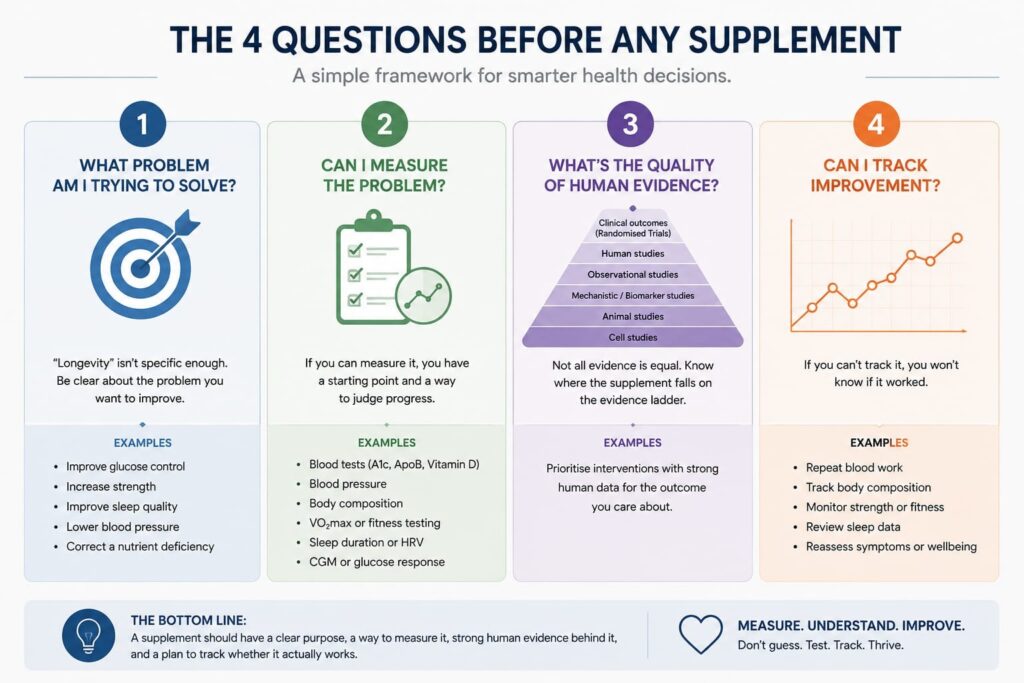
So I have started using four questions whenever I consider a supplement for myself. The first is what problem am I trying to solve? “Longevity” isn’t specific enough. I want to know whether I am trying to improve glucose regulation, correct a nutrient deficiency, increase strength, change a cardiovascular risk marker, improve sleep or support a particular training objective. If I cannot describe the problem, evaluating the proposed solution becomes difficult.
The second is can I measure the problem? Bloodwork, blood pressure, body composition, VO₂max, strength, sleep, dietary intake or, in some circumstances, CGM data can provide useful baselines. Not everything worth improving can be reduced to a number, but when a reliable measurement exists it gives us a starting point and helps prevent us from simply guessing.
The third question is what is the quality of the human evidence? Evidence that something affects cells in a laboratory, extends lifespan in a worm or mouse, changes a biomarker in a small human study, correlates with better outcomes in an observational population, or improves a meaningful outcome in a randomised trial tells us very different things. One of the easiest mistakes in longevity is allowing an exciting finding at the beginning of that evidence chain to sound like proof of an outcome at the end.
Finally, can I track whether it worked? If I am taking something specifically to improve a measurable outcome, then where practical I want a baseline, an intervention and a repeat measurement. If the thing I expected to change doesn’t move, that is useful information too.
The N-of-1 opportunity
This is one reason I’m excited about the convergence of health technology and longevity. Blood testing, wearables, CGMs, body composition, sleep tracking, cardiorespiratory testing and strength measurements increasingly allow us to follow trends and, in the right circumstances, conduct more thoughtful experiments on ourselves.
But an N-of-1 experiment still needs some discipline. We need to know what we’re testing, why we’re testing it and what result would make us continue, stop or change course. Otherwise, we may simply be copying somebody else’s supplement stack while giving it a more sophisticated name.
There is also an important boundary here. Abnormal biomarkers, diagnosed medical conditions, medications, genuine deficiencies and possible drug-supplement interactions are all good reasons to involve an appropriate clinician. Measuring ourselves should create better conversations with medical professionals, not convince us that we no longer need them.
The broader healthspan system
This is where supplements fit into the healthspan philosophy I have been developing. I start with the Six Pillars: Nutrition, Movement, Sleep, Stress, Toxins, and Purpose & Community. Then I want to understand where I am through appropriate testing, decide where I want to go, and build a roadmap containing the few changes most likely to get me there.
Sometimes the intervention is surprisingly mundane: walk more, lift weights, change what you’re eating, sleep longer, drink less or deal with a persistent source of stress. Sometimes it is a clinically indicated treatment. Sometimes a targeted supplement is appropriate. And sometimes, after understanding the uncertainty, an experimental longevity intervention may be interesting enough to try. Then comes the step we too often forget: go back and look again. Did anything actually improve?
My broader process is therefore:
Six Pillars → Test → Goal → Roadmap → Intervention → Remeasure.
Advanced longevity science can sit perfectly comfortably inside that framework. It simply doesn’t get to replace the foundation.
My 100th-birthday test
My own longevity goal is very tangible: I want to ski and play tennis on my 100th birthday. There is no biomarker that can guarantee I will get there, and biology, luck and events outside my control will have plenty to say about it. But having a concrete goal forces me to think about what I actually need my body and brain to be capable of doing.
I will need muscle, strength, balance, mobility and cardiorespiratory fitness. I want good metabolic and cardiovascular health because avoiding or delaying preventable disease gives me a better chance of preserving those capabilities. I will need my brain to work and, just as importantly, relationships, community and enough purpose that reaching old age still feels worthwhile.
I don’t particularly care whether I have the highest NAD level in Park City. If raising NAD is eventually shown to help preserve one of the capabilities I care about, then it becomes interesting to me. The same applies to senolytics, spermidine, peptides, regenerative medicine and whatever the longevity industry invents next. I am open to all of it, provided we remain clear about the problem we are trying to solve and honest about the quality of evidence behind the proposed solution.
That is what I think was missing from the whiteboard that started this article. I wouldn’t necessarily erase NMN, PQQ, spermidine, resveratrol or everything else written there. I would simply add four questions above them: What are we trying to improve? Can we measure it? What’s the quality of the human evidence? Can we track whether it worked?
The longevity industry is going to give us an extraordinary number of new things to measure, swallow, inject, wear and try over the next few decades. Some may turn out to be genuinely transformative. Others will probably disappear as quickly as they arrived. The more choices we have, the more important it becomes to have a process for deciding between them.
Don’t start with the stack. Start with the human.
And here’s my challenge: look at the supplements you’re taking today and pick one. What problem are you taking it to solve, can you measure that problem, what’s the quality of the human evidence behind it, and do you know whether it’s actually working?
Share the supplement and your answers in the Q&A below. I’m particularly interested in the ones where you’re not sure. Those may turn out to be the most interesting conversations.
Evidence notes
This article reflects my personal framework and interpretation of the available evidence and is not medical advice. Supplement decisions can depend on medical history, medications, diet, laboratory findings and other individual factors. Where a supplement is being considered to treat an abnormal biomarker, deficiency or medical condition, discuss it with an appropriately qualified clinician.
Key sources include the NIH Office of Dietary Supplements guidance on vitamin D, iron and exercise supplements; systematic reviews of glycine and CoQ10; and the NIH’s 2025 analysis of taurine as an ageing biomarker.