
For more than twenty years, Burning Man existed somewhere on the periphery of my life.
When I lived in New York in the early 2000s, I occasionally found myself at Burner events raising money for an art car or some improbable project destined for a desert in Nevada. I didn’t really understand what Burning Man was. From the outside, it appeared to involve a lot of alternative-lifestyle people building strange things, dressing strangely and disappearing into the desert for a week. It seemed almost deliberately constructed as the antithesis of the New York I inhabited at the time: banking, finance, technology, restaurants, taxis, schedules, money and ambition.
I liked electronic music, though, and somewhere in the late 2010s I was invited to a Robot Heart event in Brooklyn. I went and had a whale of a time. Over the years, dozens of friends from my New York and technology communities started making the annual pilgrimage, some as DJs, others building camps or art, and many simply because they had discovered something there they couldn’t quite reproduce anywhere else.
Still, Burning Man remained one of those things I would probably do one day.
Three children made that particular day difficult to find. Some important birthdays fall around the beginning of September, along with back-to-school, and disappearing for a week or more in the name of ‘self-care and exploration’ isn’t necessarily the easiest family calendar request to make. I almost went in 2025 when close Park City friends invited me to join their camp, but a work conflict killed the plan last minute.
Then 2026 came around. I was recently divorced, my work schedule finally gave me the freedom to go, and several friends were making the trip, including someone I knew through Summit Series who was heading to their first Burn too. For the first time, there really weren’t many excuses left. I bought a last-minute ticket through STEP, Burning Man’s official Secure Ticket Exchange Program, and started trying to understand what exactly I had signed myself up for.
Even the ticketing is unusual. In 2026, public tickets ranged from $550 through $3,000, with Burning Man saying that $775 covered the cost per participant. Higher-priced tickets help widen access, fund Honoraria art grants and underwrite Black Rock City operating costs. Before you even arrive, there is a subtle message embedded in the economics: this isn’t simply about buying the best seat you can afford. In fact, there aren’t any seats at all.
You don’t attend Burning Man. You help build it.
For someone who has never been, this may be the most important distinction. Burning Man isn’t really a music festival, although there is extraordinary music. It isn’t an art festival, although the art is unlike anything I’ve experienced elsewhere. It isn’t a wellness retreat, although you could spend days doing yoga, meditation and bodywork. And it isn’t simply a giant party, although you can certainly party until well after sunrise. It’s better understood as a temporary city and a social experiment.
Its culture is organised around ten principles: Radical Inclusion, Gifting, Decommodification, Radical Self-reliance, Radical Self-expression, Communal Effort, Civic Responsibility, Leaving No Trace, Participation and Immediacy. Written down, they can sound slightly earnest. They feel considerably less so when you’re standing in a dust storm wearing goggles while somebody dressed as a pirate hands you freshly cut mango. But the principles matter because they explain the place.
For a first-time Burner, the logistics boil down to two questions: where are you going to camp, and how are you going to get there? You can largely fend for yourself, camp with friends, or join one of the organised theme camps that collectively create much of Black Rock City. Some have communal kitchens and showers; others create bars, music venues, yoga, bodywork or wonderfully strange interactive experiences. Somewhere, at some ridiculous hour of the morning, somebody will probably hand you a grilled cheese sandwich or a glass of champagne for sunrise.
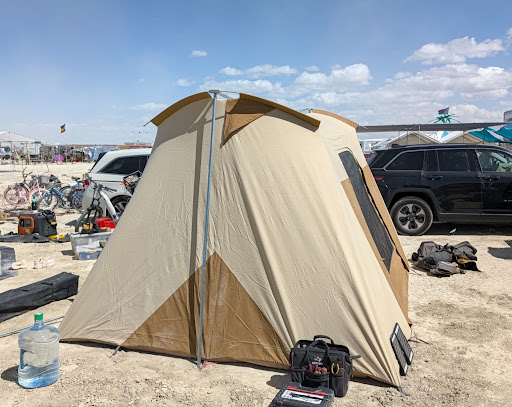
I chose a tent, no air conditioning, and a camp of around thirty people. It felt like the right balance for my first Burn: roughing it enough to experience the desert properly, but with a community around me if things went sideways. As it turned out, I’d need considerably more of that support than expected.
There isn’t a correct way to do your first Burn, but joining an established camp means understanding that you are joining something rather than purchasing something. Participation matters, and paying more isn’t supposed to substitute for contributing.
Then you have to get yourself and an improbable amount of stuff into the desert. You can drive and tent, bring an RV, or fly into Reno and take the Burner Express bus. The much-maligned influencers [sample video here] take a slightly different approach, flying directly onto the playa by small plane or, at the more spectacular end, private helicopter. You can travel solo or make the journey part of the experience by arriving with campmates. Then comes the rather significant question of what on earth to bring.
Ask a regular Burner for their packing list and you may regret it. It will be long. Very long. It starts with everything you’d expect for surviving a week in the desert, then descends into things you had no idea existed, let alone needed. This year I discovered the pee bag. Yes, this is a thing, and remarkably useful when the alternative is abandoning your favourite DJ and trekking through a dust storm in search of a distant portable toilet. Find something approximating a squat amongst the dance floor, deal with the matter at hand and return to the beats as though nothing unusual has happened.
Then there’s the bike. At Burning Man it isn’t really optional. Black Rock City and the open playa are enormous, and almost everyone gets around on two, or occasionally three, wheels. E-bikes, ancient beach cruisers, fat bikes and wonderfully impractical tricycles become moving light installations at night, covered in LEDs partly for self-expression and partly because finding an unlit bicycle amongst several thousand others would be hopeless.
There were plenty of other improbable things that proved surprisingly useful, but I won’t spoil the discovery process. Part of preparing for your first Burn is staring at somebody else’s packing list wondering why on earth you need half of it. Part of the experience is discovering the answer.
Lesson One: You’re Not in Control
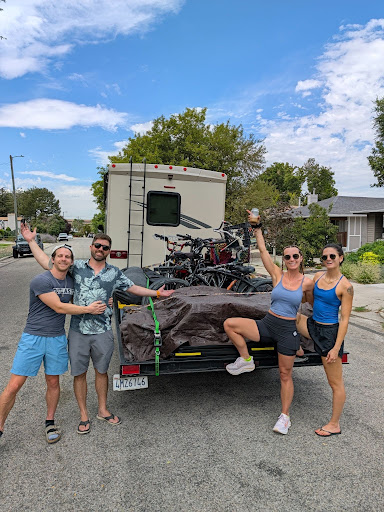
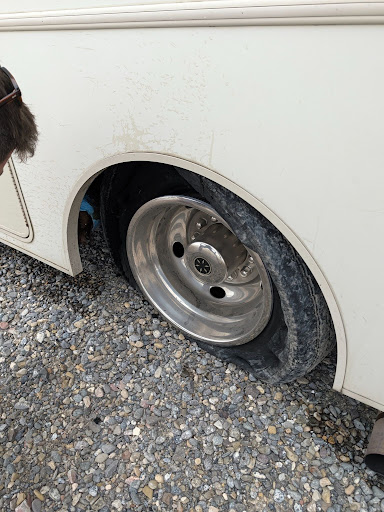
I chose to help a few campmates drive an RV from Salt Lake City to the playa, a journey that can apparently be done in about eight hours with a fair wind. Ours took fourteen. Somewhere along I-80 on Friday evening, travelling at around 75 mph in a massive Winnebago pulling a heavy trailer, our cabin conversation was brought to a fairly abrupt halt by the unmistakable sound of a tyre letting go. Our friend behind the wheel somehow managed to keep the RV straight, avoid fishtailing the trailer and get the whole lumbering contraption safely onto the hard shoulder. We climbed out to discover not one flat tyre, but two. And, naturally, no spare.
Sitting beside I-80 waiting for help, I started wondering whether this was some kind of omen for my first Burning Man. In retrospect, perhaps it was, just not in the way I imagined. Before we’d even reached the playa, Burning Man had begun the process of dismantling my expectations about schedules, plans and the comforting illusion that I was in control of either. Things would happen when they happened. We would get there when we got there. That turned out to be less an inconvenience than one of the recurring themes of the entire experience.
 |  |
Welcome to the Navel Museum
I arrived early to help with setup, and I’m very glad I did. Before the city fills, you get to see what is actually happening: containers being opened, structures assembled, shade built, cables laid, kitchens erected, art installed and people turning an empty patch of Nevada desert into a neighbourhood. It is also a wonderful way to meet your campmates before the madness begins. Within a few days, the transformation is extraordinary.
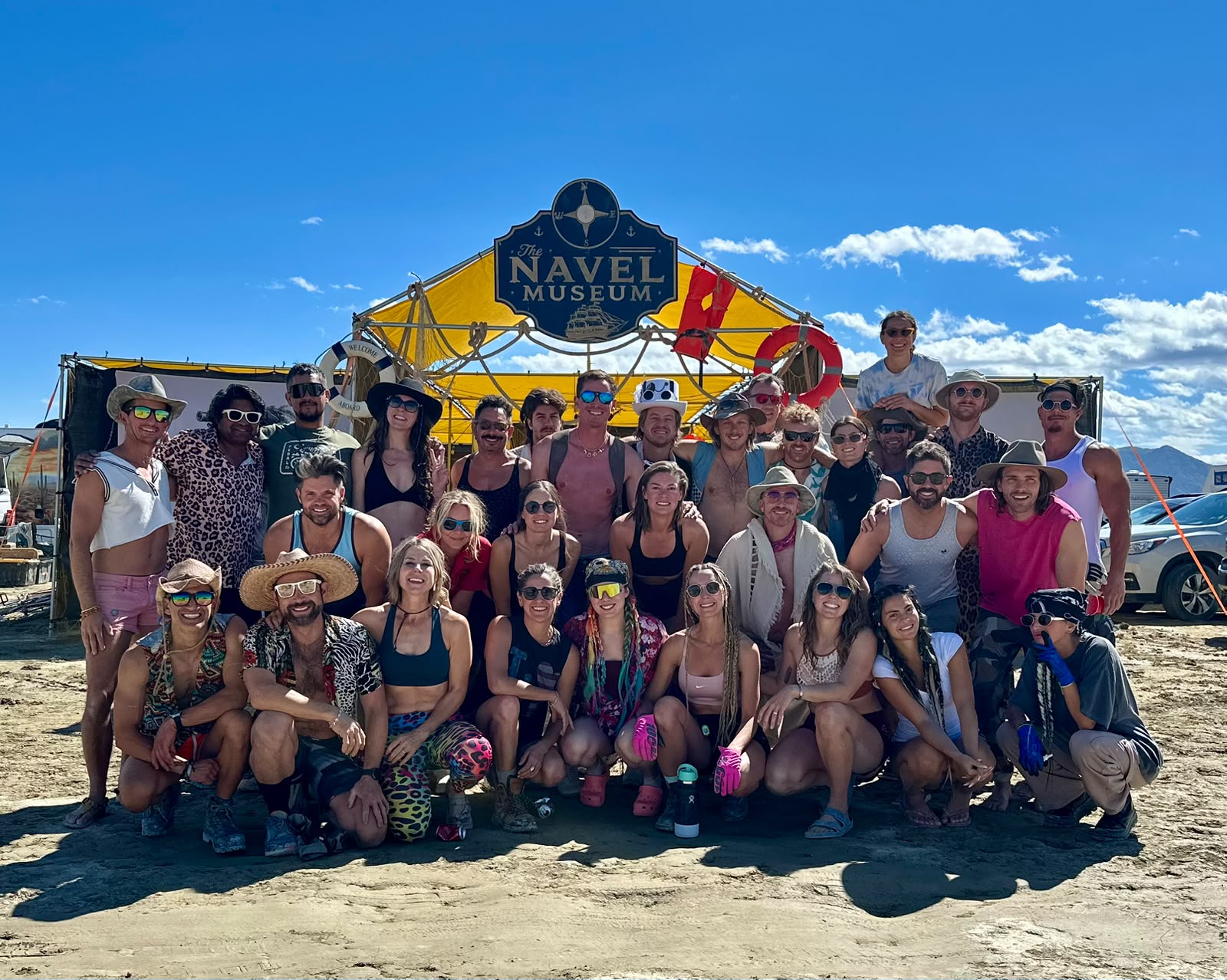
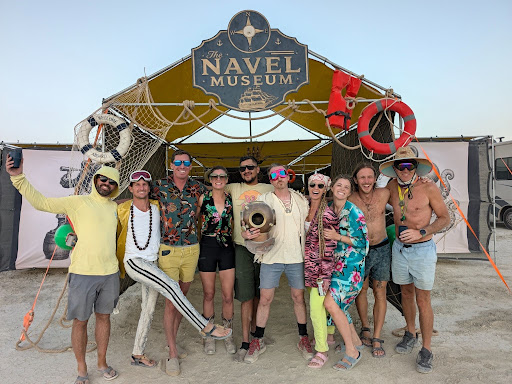
Our camp had previously been known as the Church of Chill and had become known, among other things, for serving grilled cheese sandwiches deep in the playa. This year it evolved into The Navel Museum. That’s Navel not Naval, not a typo.
From the outside, we presented something vaguely resembling a serious museum celebrating maritime history. Step inside and you discovered that we were actually celebrating the considerably less documented history of the human belly button. There was navel-inspired artwork. A lint museum. Belly-button stamps. Selfie photographs and various exhibits that became increasingly ridiculous the longer you inspected them.
 |  |
It was completely absurd. And people loved it. That was one of my first lessons about the creativity of Burning Man. In the default world, we are constantly asking whether something has a purpose, whether it can make money, whether somebody will fund it or whether it advances some larger objective. At Burning Man, people expend extraordinary amounts of time, money and energy making things simply because they think those things should exist. Sometimes usefulness is overrated.
Then you see the playa
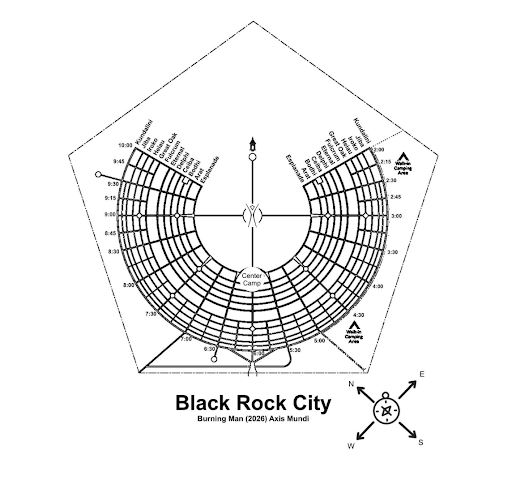
Nothing had prepared me for the scale of the art. Black Rock City is laid out like a giant clock, with radial avenues and concentric streets creating what Burners generally refer to as “the city”, a surprisingly navigable collection of neighbourhoods once you get your bearings. Beyond it lies the open playa, an enormous expanse dotted with hundreds of art installations that can look completely different depending on whether you encounter them at midday, sunset, midnight or sunrise.
Some use LEDs. Some transform with the changing light. Some breathe fire. Some move. Others are enormous architectural constructions sitting inexplicably in the middle of a desert, with no obvious reason for existing beyond the fact that somebody imagined them and then somehow persuaded a group of people to build them.
At the centre of it all is the Man, the illuminated figure that gives Burning Man its name, raised high above the playa on an enormous wooden structure. More than the symbolic centre of the event, it quickly became my most important navigation tool. Wherever I found myself, day or night, I could look for the Man, work out roughly where I was and point my bike towards wherever I was trying to go next. In a city where almost everything else seems designed to distract you from your intended destination, he became my North Star.
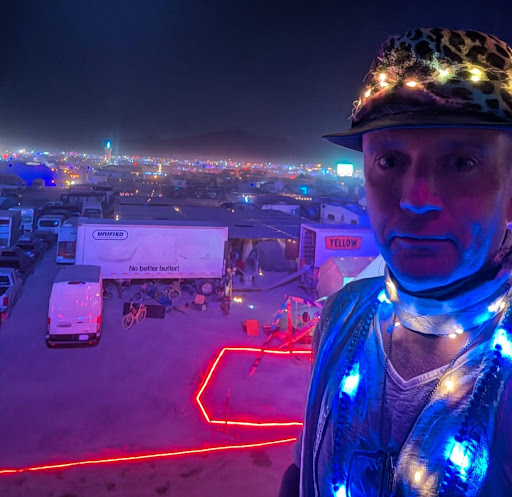
Trying to describe the scale in words doesn’t really work. And then night arrives. The first time I climbed high enough to look across Black Rock City after dark, I finally began to understand it. Lights stretch seemingly forever in every direction. Camps glow. Art cars drift across the playa like enormous illuminated sea creatures. Bikes are wrapped in LEDs. People are wrapped in LEDs. Giant pieces of art flash, pulse, move and breathe fire in the distance. The whole thing looks less like Nevada and more like a civilization from another planet.
And perhaps the most extraordinary part is knowing that none of it is really supposed to be there. A city of roughly 70,000 people, complete with streets, neighbourhoods, infrastructure, art, music and its own peculiar culture, has risen from an empty desert in a matter of days. A week later, almost all of it will be gone again. It is spectacularly impractical, economically irrational and wonderfully absurd. Thousands of people expend extraordinary amounts of money, time, ingenuity and physical effort to build something magnificent that they know, from the beginning, is designed to disappear.
 |  |
From Brooklyn to the desert
Somewhere in the middle of all this, another circle closed for me. Robot Heart had been one of my first meaningful encounters with Burner culture back in New York. I remember the Brooklyn event primarily as a bloody good night out: great music, interesting people and a glimpse into a culture I knew almost nothing about. Almost a decade later, I found myself beside the Robot Heart bus on the playa watching a sunrise set.
Sunrise at Burning Man does something strange to electronic music. You have probably been awake all night. You are dusty, slightly delirious and surrounded by people with whom you may have shared hours of dancing without exchanging more than a smile. Then the black horizon begins turning amber. The mountains slowly reappear. The temperature changes. Suddenly you can see the faces of all the people who have been dancing beside you in the darkness. The music feels different.
Robot Heart in Brooklyn had been entertainment. Robot Heart at sunrise felt emotional. Perhaps part of that was simply the passage of time. I found myself thinking about the person who had first encountered this strange Burner world in New York and everything that had happened between then and now: businesses built and lost, New York giving way to Park City, three children growing up, friendships changing and people arriving and disappearing from my life. Somehow this ridiculous illuminated bus in the Nevada desert had become a marker between two versions of me.
As the sun came up, I realised that perhaps I hadn’t waited too long to come to Burning Man. Perhaps I’d arrived exactly when I was supposed to.
When the playa disappeared
Of course, eventually the desert reminds you that this entire improbable city exists only with its permission. I had been warned repeatedly about the dust storms. Bring a mask. Bring ski goggles. Keep them with you. Everyone warns you about the dust storms. But really, I wondered, how bad could they actually be?
Bad. Really bad.
For the first few days, the desert seemed determined to make all those warnings look slightly ridiculous. It was hot, certainly, but not unbearable. The air was calm, the skies were clear and the views stretched seemingly forever across the playa. By the third night, I had started to think perhaps we’d simply got lucky.
We hadn’t.
We had ridden deep into the playa to find two art cars playing to a growing midnight crowd. Bass was pumping into the desert and hundreds of bicycles were scattered around us, their elaborate LEDs glowing like peacocks’ tail feathers. Part self-expression, part mating display perhaps, but also an extremely practical way of finding your bicycle amongst several thousand others in the dark.
The wind began almost imperceptibly. A breeze became something stronger, and soon the dust was swirling around our feet as much as we were. The stage that had been perfectly clear moments earlier began disappearing in front of us, and the music somehow seemed more distant. Then came a few drops of rain, followed almost immediately by hard hail.
It changed incredibly quickly. You could see the experienced Burners react before the rest of us really understood what was happening. Backpacks were checked, goggles went on and people started moving like birds taking flight before a storm. Our group of twelve made a beeline for our bikes, thankfully marked by a glowing die about ten feet in the air, and set off towards the city in a tight pack.
Within minutes, visibility dropped from twenty feet to almost nothing. Twelve became eight, and then, remarkably quickly, just three.
I couldn’t see the others anymore. At moments I could barely see my own hand. The music disappeared completely, swallowed by the wind and replaced by our increasingly desperate calls to one another, almost like whales using sound to locate each other across an ocean.
What struck me was how quickly the mood changed. Minutes earlier there had been music, dancing and whatever chemical assistance some people had chosen for the evening. All of that vanished instantly. The buzz was gone, replaced by something considerably more primal: fear. Real fear. Not where are we going next? or how do we find our friends? but a much simpler thought: am I actually going to make it through this?
Without sight, sound became our navigation system. I just kept pedalling. My borrowed bicycle was a twenty-year-old cruiser that had seemed perfectly charming a few hours earlier. Now every turn of the noisy crank felt as though it might be its last. I had no idea whether we were actually travelling in a straight line or merely convincing ourselves that we were.
One thought kept repeating in my head.
Keep pedalling. Don’t stop. Don’t get left out here alone.
For what felt like an eternity there was almost nothing. No landmarks. No lights. No music. Just dust, wind and the uncomfortable realization that I hadn’t brought enough water or food to comfortably sit this thing out if I became completely lost.
Then, after what felt like an eternity of pumping my legs through the deep drifts of playa dust the storm had rearranged around us, another sound finally emerged from somewhere ahead. At first it was barely distinguishable from the wind, but then it became unmistakable: the distant, competing boom of Black Rock City. I don’t think music has ever sounded so reassuring. The overlapping beats that had seemed almost comically excessive a few hours earlier suddenly sounded magnificent.
We kept riding towards the sound until a faint glow began to appear through the dust. At first it was little more than a smudge of light, but slowly the city materialised again. Camps, art, people, safety. My heart was pounding, but for once it wasn’t keeping time with the drums.
When the dust settled there were only three of us together. We didn’t know where the other nine were. There was no sensible way of going back to look for them, so we found the nearest shelter and waited for the storm to pass. Eventually we discovered everyone else had made it back too, just by different routes.
I’d heard the phrase radical self-reliance countless times before arriving at Burning Man. That night it stopped being a principle printed on a website and was forever ingrained in me.
You are surrounded by tens of thousands of people, extraordinary technology, enormous art installations and enough light and sound to create the illusion that humanity has somehow conquered this patch of desert.
Then the wind blows, the entire city disappears and suddenly it is just you, whatever you remembered to put in your backpack, and the person whose voice you can still hear somewhere in the dust.
The playa has a rather effective way of reminding you who’s actually in charge.
The playa has other plans
I arrived at Burning Man with plans. This turned out to be adorable.
I knew perhaps eight different groups of people attending and attempted to organise times and places to meet them. Almost every planned meeting failed. The weather intervened. Someone got distracted by an art installation. Somebody met somebody. Bikes disappeared. A dust storm arrived. An interesting sound appeared in the distance. Yet I somehow ran into many of those same people completely accidentally.
Eventually you stop fighting it. Burners have an expression for this: the playa provides. I’m not sure I believe the Nevada desert has developed consciousness, but there is something important in the idea. Most of my normal life is organised around calendars, meetings, objectives and lists. I optimise time. On the playa, optimisation becomes almost impossible. You surrender some control. And occasionally something considerably better appears.
One of my best nights of dancing happened exactly that way. I ran into a Park City friend who had come to Burning Man with his teenage son. Later, I watched the two of them DJ back-to-back together on one of the biggest stages on the playa. There was something wonderful about watching a father and son share that experience. Not sitting in an audience together. Not the father showing the son something from his world, or the son reluctantly dragging Dad into his. They were up there together, creating the experience for everyone else. I danced for hours. It was probably the best night of dancing I had all week. And I couldn’t possibly have scheduled it.
When the desert turns to mud
The weather is part of what makes every Burn different. The desert can be brutally hot during the day and surprisingly cold at night. Crystal-blue skies can disappear into dust storms with visibility measured in feet. Dust is manageable. Goggles, a face covering and some sense of direction generally get you through it. Rain is different.
On Friday evening I was watching Diplo play at Long Feng when it arrived. Anywhere else, rain probably stops the party. At Burning Man, people continued dancing outside while plastic was held over the equipment so the DJs could keep playing.
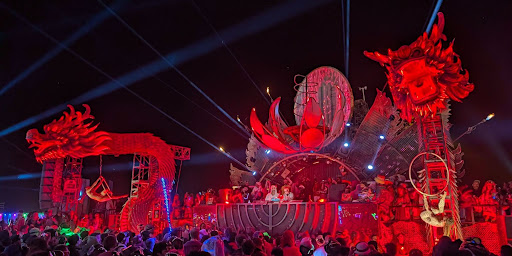 |
The individual raindrops weren’t the problem. Four hours of them were. The playa is normally fine alkaline dust. Add enough water and it turns into extraordinarily sticky mud. Bikes that had been the primary way of navigating the city suddenly became useless as the mud accumulated around their tyres. When the set finished around four in the morning, people attempted to push their bikes home. Many quickly gave up and abandoned them until the ground dried.
We had another problem. Goldfish were playing a sunrise set at Playground. Goldfish are one of my favourite electronic acts because they layer live saxophone, piano and other instruments over electronic music. I’d seen them at Park City Live in 2025 and was determined to see them again in the considerably stranger setting of a muddy Nevada desert.
Unfortunately, we were around 10 & K. Playground was around 2 & B. Our group of twelve started walking. In normal conditions it would have been a long walk. In playa mud it became a ninety-minute trudge, one deliberate foot after another, our boots collecting another layer with every step. But we made it.
About a hundred equally determined people had gathered. Goldfish were already playing and we were close enough to almost touch them. Each of my boots felt as though it weighed twenty pounds. Scraping off the mud was pointless because another layer immediately replaced it. So we danced. We danced in the mud with old friends and people we’d met five minutes earlier as the sun rose over the desert. Then, naturally, we had to walk another few miles home. It was one of the best mornings I’ve had in years.
A man dancing above the chaos
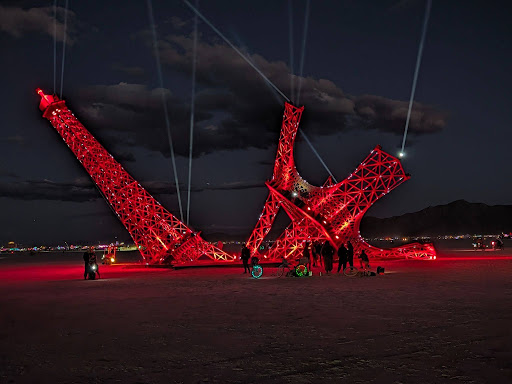
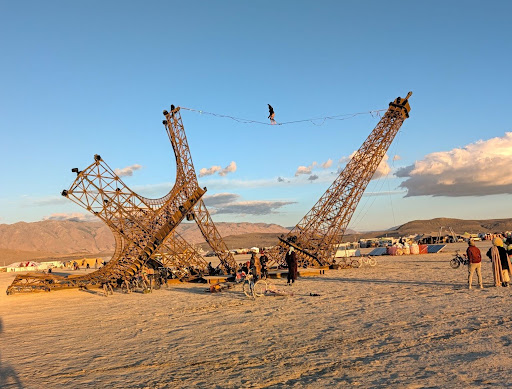
After the amazing Sunrise Goldfish set wrapped at eight in the morning, I was walking home, using the giant art installations as landmarks. As I reached what looked like a deconstructed Arc de Triomphe, someone had impossibly stretched a high wire across it. And perhaps a hundred feet above everything happening below, there was a man on it.
He wasn’t gingerly trying to get from one side to the other. He was dancing. Below him was everything Burning Man had spent the night throwing at us: music, art cars, lights, bikes, thousands of people, technology, sound and chaos. Above it was one human being balanced on a wire, moving to the music. I stopped and watched.
 |  |
For a place overflowing with technology and spectacle, some of the moments that affected me most were extraordinarily simple. One person doing something almost impossibly human.
Movement without exercise
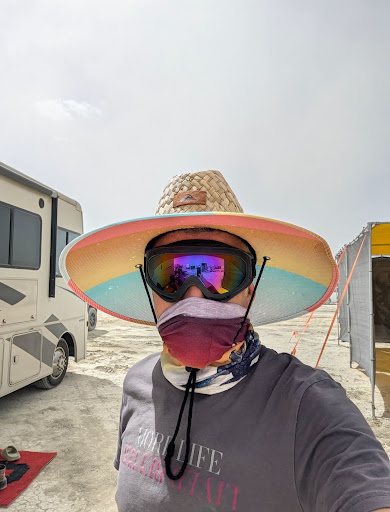
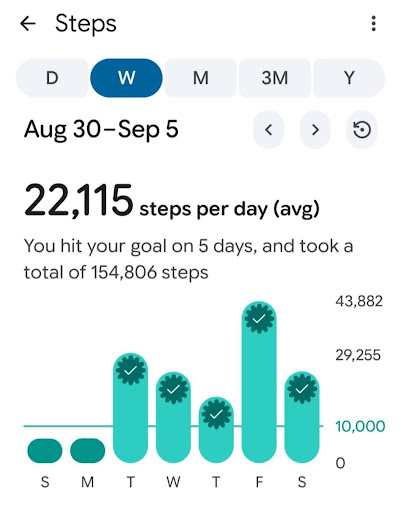
There was another thing happening to my body that I didn’t fully appreciate until I looked at my step count. At home, I think of exercise as something I deliberately do: tennis, skiing, mountain biking, a workout at the gym. On the playa, movement wasn’t something I scheduled. It was simply how I lived.
Most days I was walking roughly twice what would normally constitute a very active day for me. On my biggest day I recorded more than 43,000 steps. Using a typical adult walking stride, that is roughly 21 miles on foot in a single day, give or take a couple of miles depending on stride length. And that doesn’t include the substantial distances we covered on bikes.
 |  |
The scale of Black Rock City almost forces movement into your life. You walk around camp. You bike several miles to see an art installation. You dance for hours. You walk across the playa because the rain has rendered your bike useless. Then somebody tells you about something extraordinary happening two miles away and, somehow, off you go again.
What struck me wasn’t simply how much I moved. It was how little it felt like exercise. There was no 10,000-step target. No treadmill. No Strava goal. No obligation to close a ring. Movement had a purpose: exploration, transportation, dancing, helping the camp, finding friends and following curiosity. I was covering enormous distances, often on four or five hours of sleep, yet for most of the week I felt remarkably healthy and energetic.
That may be one of the more interesting lessons I brought home. We spend a lot of time trying to persuade ourselves to exercise when perhaps the better question is how we design lives and communities where movement is simply the consequence of living them.
I don’t think I slept more than four or five hours in any 24-hour period on the playa. Strangely, I rarely felt exhausted. My body seemed to wake when it was ready, and then I went exploring again. I don’t recommend this as a longevity protocol. But it did make me wonder why I can sometimes feel more depleted in normal life after considerably more sleep.
Maybe part of the answer was everything that wasn’t there: very little phone connectivity, almost no email, no news cycle, no commuting, no buying things, no restaurant reservations, no meetings and fewer of the endless micro-decisions about where I ought to be next. In their place were movement, sunlight, human connection, novelty, music, creativity and play. This isn’t an argument that living in a dusty Nevada desert for 52 weeks a year would improve our health. I suspect that experiment would deteriorate rather rapidly. But it is an interesting experiment in subtraction.
Naked people aren’t actually very interesting
A disproportionate amount of what gets written about Burning Man seems to involve sex and drugs. There is certainly nudity. Quite a lot of it, particularly as the week progresses. What surprised me was how quickly it stopped being remotely interesting.
I saw very little overt sexuality and almost no public sexual activity. Nudity seemed much more often to be another expression of freedom and, perhaps, a stripping away of some of the identities we manufacture in normal life. There were naked people riding bikes. Naked people playing bagpipes. Naked people waving goodbye to departing Burners waiting in line to leave the playa. At one point I found myself standing naked beside new camp friends while being sprayed with soap, foam and water. And it wasn’t remotely weird, even staring at each other’s navels seemed natural.
Instead, you notice something incredibly obvious that modern culture somehow manages to make us forget: human bodies come in an astonishing variety of shapes, sizes, ages and configurations. Nobody seemed particularly bothered. There was something wonderfully equalising about it.
Drugs are certainly present too, although perhaps not quite in the cartoonish way an outsider might imagine. Law enforcement is present, and plenty of Burners experience the week sober. There are also camps devoted to meditation, healing, yoga, bodywork and other forms of self-care. Burning Man is large enough to contain almost whichever version of it you decide to seek.
When everything is unusual, nothing is
Perhaps the thing I found hardest to explain when I came home was how remarkably judgement-free Burning Man felt. In the default world, we spend an enormous amount of energy managing how we appear to other people: what we wear, how successful we look, whether we’re behaving appropriately for our age, profession, gender or social group, whether we’re too loud, too quiet, too emotional, too strange, too naked, too enthusiastic or simply trying too hard. We talk endlessly about being authentic, but there are actually remarkably few public places where most of us feel completely safe testing what that means.
Burning Man seems to stretch the boundaries of acceptable self-expression so far that eventually there isn’t much left to rebel against. When almost everything is being done somewhere, often to an almost comical excess, the unusual stops feeling particularly unusual. The seventy-year-old riding naked across the playa isn’t demanding your attention. The man wearing an extraordinary ball gown isn’t making a statement you need to decode. The person crying beside you doesn’t need to explain themselves. Neither does the stranger dancing alone at sunrise, the couple dressed as astronauts, or someone who has spent six months building an enormous mechanical creature that breathes fire for no discernible reason. They are just being themselves.
And remarkably quickly, you stop judging them. More interestingly, you start wondering why you spend so much time judging yourself.
I wondered whether some of this was simply numbness through excess. When you’ve seen enough extraordinary things, perhaps your brain simply stops registering them as extraordinary. But I don’t think that’s quite it. What I experienced felt less like indifference and more like acceptance. There was a collective understanding that everyone was on their own journey, and provided that journey respected the safety, consent and rights of others, it wasn’t really anybody else’s job to decide whether they were doing it correctly.
Everyone seemed to be trying, in their own peculiar way, to become a more fully felt version of themselves. Some did that through outrageous costumes and dancing until sunrise. Others through nudity. Some through art, music, meditation, service or physical challenge. Some barely expressed themselves outwardly at all. Radical Self-expression doesn’t have to mean being the loudest person on the playa. Sometimes it might mean finally becoming quiet enough to hear yourself.
And somehow everybody fits. Not because everybody is the same, but almost precisely because nobody is.
I don’t want to romanticise this too much. Burning Man is populated by human beings, so judgement obviously hasn’t been eradicated from the Nevada desert. I certainly arrived carrying plenty of my own. But I could feel it falling away as the week progressed. Things that might have caused me to look twice on Monday barely registered by Thursday.
Perhaps that is one of the more uncomfortable things the playa sends you home with. Once you’ve experienced a place where people can express themselves so completely without the social machinery collapsing around them, you start noticing how much fear we carry in the default world. Some of that caution is understandable and necessary. Society needs boundaries. People need safety. Consent matters. Responsibilities don’t disappear simply because we want to be ourselves. But beyond those legitimate boundaries, I wonder how much of ourselves we suppress simply because we’re afraid of looking foolish, being misunderstood or not fitting in. We become afraid of our own shadows.
Burning Man briefly creates the opposite condition. Everyone fits in beautifully because fitting in doesn’t require becoming more like everyone else. Maybe that is Radical Inclusion at its most interesting: not merely allowing somebody different into your world, but becoming sufficiently comfortable with difference that you no longer need to measure their life against your own.
And perhaps the real freedom isn’t reaching the point where you no longer care what anybody thinks. It’s reaching the point where you don’t need to think quite so much about everybody else. That leaves considerably more room to ask the harder question: am I expressing my own journey as fully, honestly and safely as I could be?
The best grilled cheese I’ve never eaten
One of my favourite experiences of the entire week involved something considerably less glamorous. At around one in the morning Monday night, we set ourselves up deep in the playa by our favourite art car and started making grilled cheese sandwiches. Hundreds of them. People would emerge from the darkness, dusty, hungry and often several hours removed from whatever they thought they were originally going to do. We handed them hot, gooey grilled cheese. Their faces were extraordinary.
I experienced the other side of this repeatedly during the week. Someone handed me freshly cut juicy mango, salted and spiced to perfection. Someone else appeared with a perfectly cooked Argentine steak. Cold mist and shade offered during the noon sun. A ridiculous conversation while trudging through mud. Help when you need it. None of it came with a price. “The playa provides,” you will hear over and over again. And surely it does.
Burning Man deliberately tries to create a decommodified environment. There are no sponsored VIP areas to buy your way into and gifting is one of the core principles. Importantly, the gift isn’t supposed to create an obligation to reciprocate. That changes social interactions more than I expected.
In the default world, we’re increasingly accustomed to transactions. We pay for convenience, access, attention, entertainment and increasingly even community. At Burning Man, the person giving you something generally wants nothing from you except perhaps the pleasure of watching you enjoy it. That turns out to feel remarkably good on both sides.
Before going, I interpreted Radical Self-reliance fairly literally. Bring enough water. Bring food. Prepare for heat, cold, dust and rain. Know how you’re getting home. All of that matters. But after a week there, I think there is a much more interesting tension between Radical Self-reliance and Communal Effort.
You are responsible for yourself precisely so that the community doesn’t have to carry you. And once enough people take responsibility for themselves, they have capacity left to help everyone else. That is quite different from individualism. It may actually be one of the prerequisites for genuine community.
Nice day for a white wedding
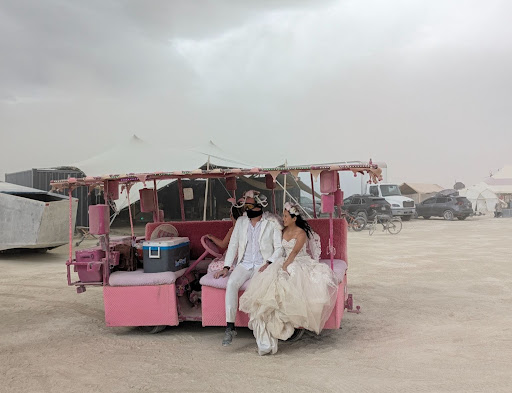
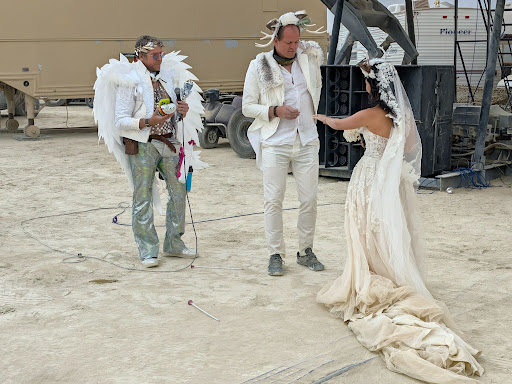
Wednesday at Burning Man is known as White Wednesday, which, as it happened, made it a rather perfect day for a wedding. Friends Oystein and Hanh from San Francisco, had decided that amongst the dust, art, music and general madness of Black Rock City, they were going to get married in front of 80 of their besties.
The playa responded by throwing them some fairly spectacular wedding weather. The wind was relentless and the dust particularly brutal that day, with repeated whiteouts sweeping across the city. It was bad enough that some of our campmates decided they’d had enough and headed home early. People who had been coming to Burning Man for years told me it was amongst the dustiest conditions they could remember. For me, as a first-timer with nothing to compare it to, it simply was what it was. A day or two of whiteouts across ten days in the desert didn’t seem like a particularly bad deal.
And there was something rather wonderful about watching a couple get married in the middle of it. Wedding photographs normally involve enormous efforts to control everything: the venue, flowers, lighting, seating, weather and precisely where everyone should stand. Here, control wasn’t really on the menu. The wind blew, the dust arrived, masks were worn, visibility came and went, and Oystein and Hanh kept smiling. Friends gathered around them, dressed in white that rapidly became a slightly more playa-appropriate shade of beige, and celebrated anyway. If you can stand beside someone in a dust storm, unable to control almost anything happening around you, and still be delighted that this is the person you’ve chosen to share it with, it seems like a reasonably good omen for married life.
It also made me think about something I’d noticed since returning home. I’ve now met a surprising number of people in the default world who either met their life partner at Burning Man or discovered there that a relationship was becoming something more serious. At first that seemed slightly counterintuitive. Burning Man isn’t exactly the environment most marriage counselors would design for testing long-term compatibility. You’re sleep-deprived, filthy, occasionally lost, living in extreme conditions and surrounded by almost unlimited distraction. On reflection, perhaps that’s precisely the point.
 |  |
Burning Man’s Ten Principles aren’t relationship vows, but quite a few translate remarkably well. Radical Inclusion: make room for the whole person you’ve chosen, including the parts you don’t completely understand. Gifting: give without keeping score. Radical Self-reliance: remain capable of standing on your own two feet rather than expecting another person to complete you. Radical Self-expression: create enough safety for each other to remain fully yourselves. Communal Effort: build something together that neither of you could build alone. Civic Responsibility: understand that your choices affect more than just you. Participation: relationships don’t work particularly well from the sidelines. Immediacy: occasionally stop planning the future long enough to notice the person standing beside you. And Leaving No Trace might require a little poetic licence in a marriage, but perhaps it means trying not to leave unnecessary damage behind when the inevitable storms arrive.
Maybe that helps explain why so many Burners seem to find one another. Shared values don’t guarantee a successful relationship, of course, and surviving a week on the playa is probably not yet an accepted substitute for premarital counselling. But there is something revealing about seeing another person stripped of many of the conveniences, routines and social armour of the default world. You get to see how they behave when the plan falls apart, when they’re exhausted, when the dust is blowing sideways, and when somebody else needs help.
So perhaps the question isn’t really whether those who Burn together stay together? I have nowhere near enough evidence for that claim. But watching Oystein and Hanh smiling at each other through a whiteout, surrounded by a community determined to celebrate them regardless of what the desert was throwing our way, I couldn’t help thinking that marriage itself might look something like this. You make plans. The weather changes. Visibility occasionally disappears. Things rarely unfold exactly as expected. And hopefully, when the dust clears, you’re still standing beside the person you chose.
Alone, But Not Lonely
One evening I ended up back at Long Feng, which had become my favourite music stage on the playa. A few acquaintances from our camp were somewhere around me, but none of the people I’d spent most of the week with. I was dancing, enjoying the music and gradually getting lost in my own head when, for some reason, I started looking more closely at the people around me.
Everywhere I looked, people seemed to be sharing the moment with someone. Couples were leaning into each other. Friends were laughing. Groups were talking animatedly between tracks, hugging, dancing and pulling each other back into the crowd. There was this extraordinary amount of joy and human energy moving around the space. And then there was me. I was standing alone.
I was dancing, certainly. I was having fun. I was happy, I think. But suddenly something felt missing. I was alone, but was I lonely? And once that question entered my head, I started wondering who I wished was standing beside me. My closest friends from the default world? My family? My children? Even my ex-wife, with whom I’d shared twenty mostly amazing years and so many experiences that had defined my adult life. Who was the person I wanted to turn towards at that exact moment and say, Can you believe this?
And then, rather unexpectedly, I started to feel sad. My eyes filled with tears. There wasn’t an obvious reason for it. Nothing bad had happened. Quite the opposite: I was standing in the middle of Burning Man, listening to music I loved, surrounded by thousands of people having an extraordinary time. Yet perhaps that was precisely why the feeling arrived. Some experiences become more valuable when there is someone you love standing beside you to remember them with. Happiness can be experienced alone, but there are moments when joy seems to want somewhere else to go.
The feeling didn’t last long. A friend appeared beside me and offered me a drink from their water pouch, one of those wonderfully ordinary acts of care that become disproportionately meaningful in the desert. Hydration is, after all, rather important on the playa. I took a drink, smiled, and almost immediately found myself pulled back into the music and the people around me.
But the moment stayed with me. Burning Man had given me enormous freedom to wander alone, follow my curiosity and disappear into my own experience whenever I wanted. Yet in the middle of all that Radical Self-expression and independence, the playa had quietly reminded me of something almost embarrassingly simple: we can be perfectly capable of being alone without wanting our most meaningful moments to remain ours alone.
Maybe that is the distinction. I wasn’t lonely because nobody was there. I was briefly lonely because the people I most wanted to share that particular moment with weren’t. And then someone handed me some water, the music carried on, and the playa reminded me that even when you arrive somewhere alone, you rarely stay that way for very long.
And then they burned the Man
Everything eventually points towards Saturday night. Tens of thousands of people begin moving towards the centre of the playa. Art cars surround the Man, glowing, flashing and pumping out music. Thousands of Burners arrive on bikes and on foot, dressed in every conceivable expression of individuality. And then the Man burns.
It is difficult to describe the sheer sensory overload. There were more fireworks than I can remember seeing in one place, including being in London for the Millennium celebrations in 2000. Around us were hundreds of art cars, dozens of competing sound systems and thousands upon thousands of people celebrating, dancing, shouting and expressing themselves. It felt like Burning Man turned all the way up.
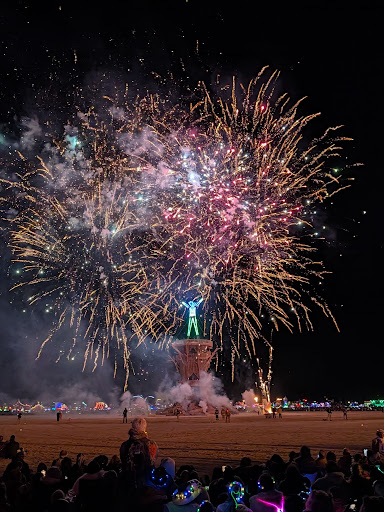 | 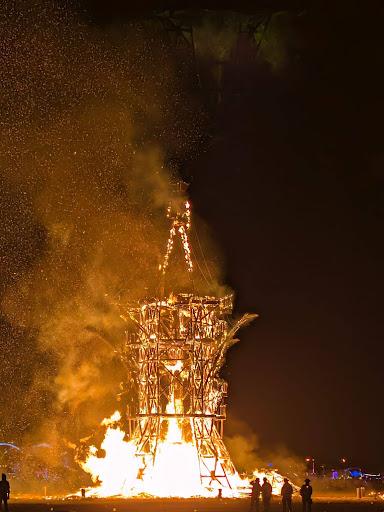 |
After a week in a city built around Radical Self-expression, participation, art and individuality, the Man Burn somehow concentrates all of it into one enormous communal release. Fire. Music. Noise. Movement. Celebration. For all the philosophical meaning people attach to Burning Man, sometimes humans simply want to gather around an enormous fire together and lose themselves in the spectacle.
But what struck me most wasn’t the Man Burn. It was what happened twenty-four hours later.
The Temple was next
On Sunday night, we returned to the playa. This time there were no competing DJs. No art cars fighting for attention. No fireworks spectacular. The Temple Burn is almost the photographic negative of the Man Burn.
Throughout the week, the Temple had become one of the most extraordinary places I visited. People covered it with photographs, letters, names and messages to people, relationships and parts of their lives they had lost. Some sat quietly. Some cried. Some hugged strangers. Others simply walked through and read. It is difficult to spend much time there without being reminded that behind every illuminated costume and smiling face on the playa is a human being carrying something.
On Sunday night, tens of thousands of the same people who had been screaming, dancing and celebrating around the Man gathered again. And sat in almost complete silence.
That juxtaposition may be my most enduring memory of Burning Man. Twenty-four hours earlier, hundreds of art cars, dozens of DJs and thousands of people had been clamouring for attention and individuality of expression, accompanied by more fireworks than I had ever seen. Now there was almost nothing. Just the sound of the fire. And people remembering.
Even writing about it now brings me back to that silence and brings me to tears, because inevitably I started thinking about what I had lost in 2026. Chester, my dog and companion for twelve years. GG, my grandmother and a huge personality in our family. And something harder to name: a little of the innocence of being a father as my teenage daughters grow up and increasingly become their own people.
None of those losses are the same. They shouldn’t be. But grief doesn’t seem particularly interested in organising itself into neat categories. You simply sit there while the Temple burns and allow whatever arrives to arrive. And for me, a lot arrived.
Something else burned too
There was another loss I found myself thinking about. Me. Or at least a version of me.
I’m beginning to think there may be an Ashley before Burning Man and an Ashley after it. That sounds rather grandiose for someone who had essentially spent a week covered in alkaline dust, dancing to electronic music and handing strangers grilled cheese sandwiches, but the change is difficult for me to describe any other way. Something shifted in my appreciation for all that humanity creates.
That feels particularly important to me right now, as we enter an era in which AI may fundamentally change much of what many of us have spent our lives doing. Careers, creativity, productivity and even some of the things from which we derive our sense of usefulness are going to change enormously.
Burning Man reminded me how much I love the messy, inefficient, irrational things humans make: a giant sculpture that took someone a year to build and will exist for a week; a DJ playing music to exhausted strangers at sunrise; a man dancing on a wire a hundred feet above the chaos; a father and his teenage son DJing back-to-back while their friends dance below them; a museum dedicated to belly buttons; a grilled cheese sandwich handed to somebody at 2am with no expectation of anything in return; a Temple built with extraordinary care specifically so people can fill it with memories and then watch it disappear into flames.
None of this is efficient. Perhaps that’s the point.
I came home feeling less interested in some of the negativity, division and constant outrage fed to us through screens, and with a renewed appreciation for the strange, beautiful things humans do when they gather together. Burning Man somehow gave me permission to hold celebration and commiseration at exactly the same time. Joy and sadness. Gain and loss. The ridiculous and the profound.
Perhaps that is what I mean when I say there is an Ashley before Burning Man and an Ashley after it. Not somebody fundamentally reinvented by a week in Nevada, but someone slightly more willing to notice what other people are carrying, to explore either joy or sadness when it appears, and to appreciate the extraordinary amount of humanity that exists underneath all the noise.
And Just Like That, It Was Over
And before it had really even started, or at least that’s how it felt, it was time to pack everything up and leave. Time flies when you’re having fun, apparently even when your days and nights have become almost indistinguishable from one another.
Our camp did an extraordinary job of getting everyone up early for strike, including people who had managed perhaps two hours of sleep. The Navel Museum began disappearing in reverse. Pictures came down. Wall coverings were folded and packed. Tent structures were dismantled. Grey water was divided amongst the RV owners to be carried off the playa. The kegs were drained of the last of the juice that had helped stimulate so many wonderfully strange conversations during the week. Everything that had taken days to construct disappeared in a few hours into Home Depot containers, which were stacked inside the U-Haul that had sat silently beside us all week, apparently waiting for precisely this moment.
And then it was gone. The Navel Museum, our kitchen, our shade, our bedrooms, our little neighbourhood and everything that had briefly made this particular patch of desert ours had disappeared. All that remained was an empty rectangle of playa dust and a few plastic flags identifying a place that, for one week, had been 7:45 & D. There was something slightly unsettling about how quickly it happened. A place that had contained so much life, laughter, conversation and absurdity had returned to being almost nothing.
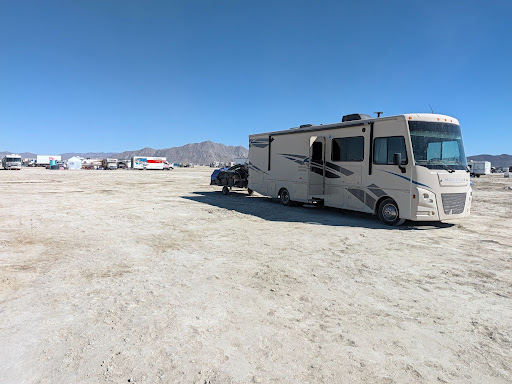
Leaving Burning Man, I discovered, can take as many forms as arriving. Some people return exactly as they came. Others leave early, find a ride with new friends or, rather impressively, reach the final day without having any clear idea how they’re getting home and begin looking hopefully for a spare seat in an RV heading vaguely towards wherever they live. I had promised a new campmate that I’d help share the twelve-hour drive back towards Salt Lake City. The optimistic plan was to leave late morning and be home around midnight.
Of course it was.
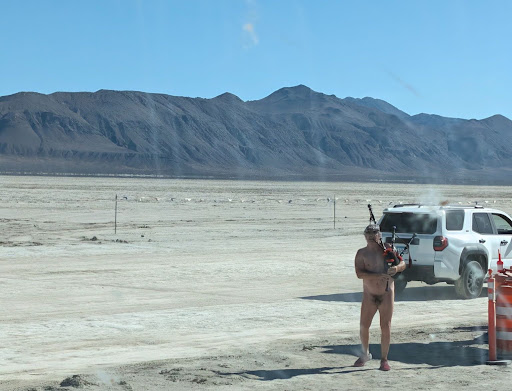
By six that evening we were finally rolling towards the exit, joining the long procession of vehicles leaving Black Rock City. Our final farewell from the playa came from a naked bagpiper standing beside the road playing us out, which by this stage seemed entirely appropriate. The daylight drive we’d imagined had disappeared with the rest of our plans, and we now had a night crossing ahead of us.
 |  |
Or, more accurately, I did. My fellow driver had perhaps embraced the final night a little too enthusiastically, and my Spidey senses suggested that handing him the keys to a massive RV pulling a trailer would not represent my finest decision of the week. So I found a thriller on audiobook, settled behind the wheel and headed towards I-80 alongside thousands of other Burners, all of us with Black Rock City slowly disappearing in our rear-view mirrors.
The drive was long and exhausting, but thankfully uneventful. Eventually, at around six in the morning, I crawled into my own bed and closed my eyes for my first night’s sleep in a real bed in ten days.
And almost immediately, I was back on the playa.
My dreams were vivid: fragments of people, bikes, art, music, dust and experiences that seemed to pick up wherever the week had left off. I assumed it was simply my brain processing an unusually intense ten days. Except it happened again the following night. And the next. In fact, almost every night since returning, some part of Burning Man has found its way into my dreams.
So apparently leaving the playa is easier than getting the playa to leave you.
Perhaps that’s fitting. We had spent our final morning obsessively making sure we left no trace of ourselves behind in the desert. What I hadn’t considered was that Burning Man had made no such promise about leaving no trace of itself behind in me.
What comes back with you?
Eventually Burning Man disappears. That’s part of the deal. The Man burns. The Temple burns. The camps come down. The art leaves. Tens of thousands of people eventually make their way back towards jobs, families, schools, mortgages, emails, deadlines and all the other things Burners rather brilliantly call the default world.
I’ve only been back in the default world for a few days, and people keep asking me the obvious question: What did you bring back with you? What had the biggest impact? The truthful answer is that I don’t really know yet. For me it wasn’t a desire to dress differently, abandon my calendar or spend the rest of my life following art cars around the desert. There were too many things, affecting me in different ways, and I suspect some of them won’t reveal themselves for months or perhaps years. But yesterday something happened that gave me a small, very tangible example of how the playa had already changed the way I see the world.
One of Burning Man’s Ten Principles is Leaving No Trace. I was the last person from our camp to leave, which meant doing a final walk across the site looking for anything we might have left behind. Not just obvious rubbish, but tiny pieces of plastic, scraps of tape, anything that didn’t belong on the playa. We even took our grey water with us. The objective is quite literal: when Black Rock City disappears, the desert should not contain evidence that you were ever there.
Yesterday I was at my son Dash’s soccer game in Salt Lake City, a very normal part of my default-world life. He’s on several teams, so most weeks involve some combination of practices and games, with me pacing the sidelines as the supportive, occasionally overenthusiastic dad and wannabe coach. At some point I looked down and noticed a candy wrapper beside my feet, probably the remains of some previous player’s post-game energy boost. I bent down and picked it up.
Then I noticed another piece of rubbish a few yards away. And another. Against the bright green grass, each one suddenly seemed strangely conspicuous, almost glowing at me. I went back to the car, found a grocery bag and started walking the sideline picking things up. I could see a few of the other parents looking at me slightly oddly. Picking up a piece of rubbish isn’t particularly strange. What was perhaps strange was how maniacal I became about it. Twenty minutes later, I’d filled the entire grocery bag and had barely covered a small section of the pitch.
There weren’t any rubbish bins nearby, so I put the bag in my car, sat back down and watched the rest of the game. I didn’t think much more about it until later. Then it struck me: I don’t think the pre-Burning Man version of me would have done that. I might have picked up the wrapper at my feet, but I doubt I would have fetched a bag and spent twenty minutes clearing everyone else’s rubbish from a soccer field. Something had shifted. The rubbish wasn’t mine, but somehow the responsibility for leaving the place better than I’d found it felt like it was.
Perhaps that’s how experiences actually change us. Not through some grand declaration that we’ve returned as a different person, but through tiny changes in behaviour that we barely notice ourselves. A candy wrapper on a football pitch. A conversation with a stranger. A little less judgement. A little more willingness to leave the calendar empty. Small moments when something learned in one world quietly follows you into another.
I have no idea whether I’ll still be roaming the sidelines of Dash’s soccer games collecting rubbish six months from now. Perhaps this is simply the temporary afterglow of an intense week in the desert. But for now, at least, Leaving No Trace followed me home. And perhaps the more interesting question isn’t what we leave behind when we leave the playa, but what the playa leaves behind in us.
I’ve deliberately left a lot out of this article. There were dozens of other extraordinary experiences, conversations, parties, pieces of art, acts of generosity, strange encounters and moments of complete absurdity that I could write about. I’m not going to.
Partly because this isn’t supposed to be an audit of my week or a chronological diary of everywhere I went and everything I did. More importantly, discovery is part of the gift. Before I went, people tried to explain Burning Man to me. Now I understand why they generally failed. You can describe the Man. You can show somebody a video of Robot Heart at sunrise. You can explain the street system, the dust, the camps, the gifting and the art. But if I told you everything, I’d be robbing you of some of the point.
Your Burning Man shouldn’t be mine. The best moments may be the ones nobody told you to look for.
And it’s a wrap
To sum up the rest of it, Burning Man is creativity without a business model. Generosity without a transaction. Community without an algorithm. Dancing without worrying who is watching. Grieving without needing to explain why. Talking to strangers. Being uncomfortable. Getting lost. Finding people accidentally. Making ridiculous things simply because they might make somebody smile.
Maybe that is why Burning Man is so difficult to explain to someone who hasn’t been. From the outside it looks like a party. From the inside, at least for me, the party turned out to be the least interesting part.
I waited more than twenty years to go to Burning Man. I’m rather glad I didn’t go earlier. I think I went exactly when I needed to. I look forward to going back and helping others unlock the magic of the playa for themselves.
If you’ve been to Burning Man, what came home with you that you didn’t arrive with? And if you’ve never been, what part of yourself would you have to let go of to find out? Leave me a note below and keep the conversation going.
Sources / fact-check notes
Burning Man Project, ‘The 10 Principles’ – official descriptions of Radical Inclusion, Gifting, Decommodification, Radical Self-reliance, Radical Self-expression, Communal Effort, Civic Responsibility, Leaving No Trace, Participation and Immediacy.
Burning Man Project, ‘Black Rock City 2026 Ticketing Information’ – 2026 ticket tiers, $775 cost-per-participant statement, higher-tier support for access, Honoraria art grants and Black Rock City operations, and STEP as the official Secure Ticket Exchange Program.
Audio narration: Written by Ashley John Heather and narrated using an AI-generated version of Ashley’s voice.
© 2026 Ashley John Heather. All rights reserved. This recording and accompanying article may not be reproduced, distributed or republished without permission.

One Response
I would welcome your feedback on this post, from both burner curious, as well as those who have been many times before. Thank you for taking the time to read or listen to what I had to say! Ashley John Heather.